Sunderland's Council Tax Reduction Scheme Has Rules You Won't Find on One Page
You know you might qualify for Council Tax Support. You've looked at sunderland.gov.uk, found the scheme summary, clicked through to the application portal — and realised you still don't know whether your Universal Credit claim counts as an application (it doesn't), which of Sunderland's five income bands applies to your household, or whether you could qualify for a 100% award under the scheme the council adopted in April 2025.
The council's information is accurate, but it's scattered across summary pages, downloadable policy documents and annual budget leaflets. You're left cross-referencing three or four sources just to work out whether claiming is worth the effort — and the application itself asks for evidence you might not have ready.
The Sunderland Council Tax Claim Roadmap
This guide brings every piece of Sunderland's 2026/27 Council Tax Reduction scheme into one document, with the local rules already applied. No national overviews, no "check with your council" — just the income bands, the non-dependant deduction rates, the capital limit and the calculation steps that apply to your Sunderland bill.
It's built for working-age residents who want to handle their own claim without waiting for a drop-in appointment. The guide walks you from "do I qualify?" through to a submitted, properly evidenced application — and if the answer comes back wrong, through the reconsideration and appeal process too.
What's Inside
- Sunderland's income-banded calculation, step by step — the five income bands, the 100% maximum award for the lowest band, and the household thresholds explained with three worked examples on real Band A and Band B figures, so you can estimate your award before you apply.
- The UC boundary, made clear — Sunderland requires a separate Council Tax Support application even if you're on Universal Credit. The guide explains exactly where the DWP's responsibility ends and the council's begins, so you don't lose months assuming it's automatic.
- The zero non-dependant deduction rule — most English councils deduct £4.65 to £11.95 per week from your award for each non-dependant adult in your home. Sunderland's adopted working-age scheme applies zero. The guide explains exactly how this works and how to verify it on your decision notice.
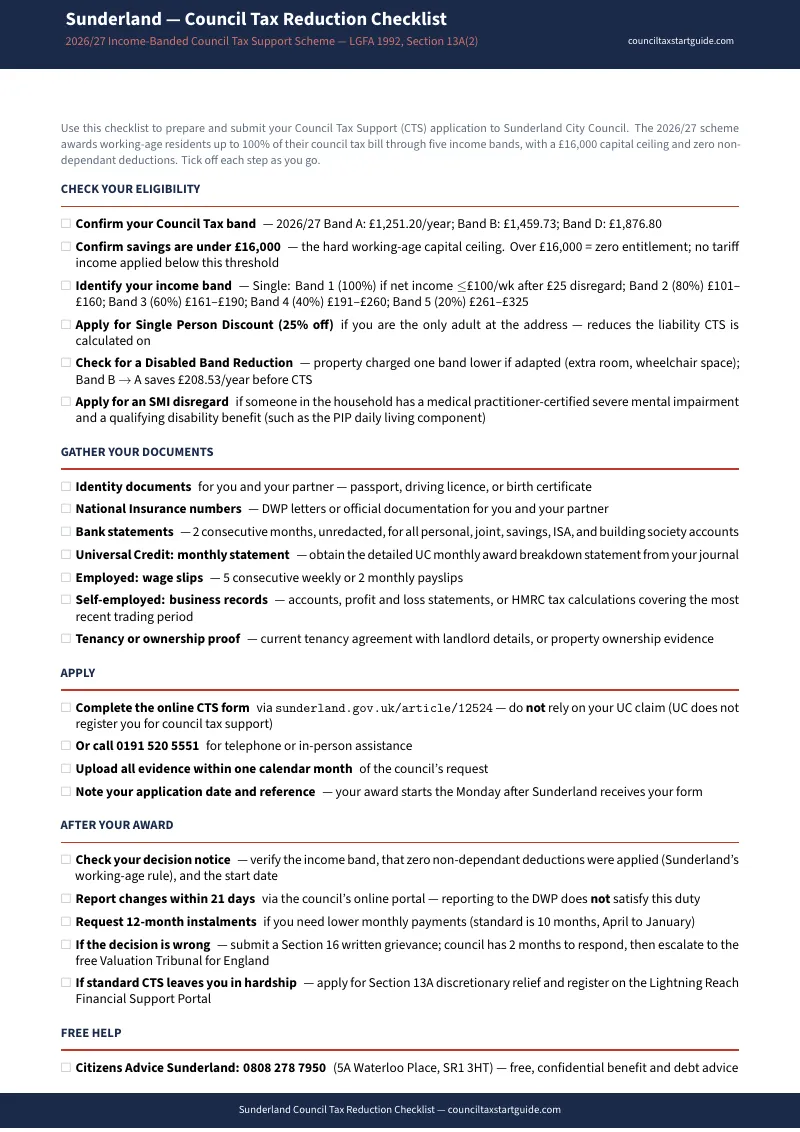
- Evidence checklist — every document the online form asks for, in the order it asks for them: identity, National Insurance, earnings, bank statements, tenancy details and capital proof. Gather them before you start, avoid session timeouts.
- 1-month backdating template — the working-age backdating window is strict. The guide includes a structured statement template that shows how to document continuous good cause, with the evidence types the council's own backdating form requests.
- Section 13A hardship fund preparation — when your remaining council tax bill after the standard award causes genuine financial distress, the council has discretionary powers to reduce it further. The guide lays out how to structure a hardship application with a household budget statement.
- Change-of-circumstance log — a printable tracker for recording income changes, the dates you reported them and the council's reference numbers, protecting you against overpayment penalties of £70 to £280.
- Reconsideration and appeal steps — what to do if your application is refused or your award looks wrong, from informal review through to the Valuation Tribunal.
Who This Guide Is For
- Working-age Sunderland residents on a low income or Universal Credit who want to claim Council Tax Reduction
- Households with fluctuating hours or zero-hours contracts who need to understand how variable income affects their award
- Family members helping a relative prepare and submit an application
- Anyone who has been refused a backdating request and wants to understand the good cause standard
- Residents who received their annual bill and want to check whether they're missing a reduction they're entitled to
Why Not Just Use the Council Website?
The council website tells you Council Tax Support exists and gives you the application link. What it doesn't do is walk you through the calculation — the applicable amounts, the taper rate, the interaction between Universal Credit elements and the local scheme — in a single document you can sit with at the kitchen table.
Citizens Advice Sunderland, ShARP and SWAP offer free, expert help and you should absolutely use them if you can get an appointment. But drop-in sessions at Waterloo Place fill quickly, and if you work shifts or care for someone at home, waiting for a weekday morning slot may not be realistic. This guide is available whenever you need it.
Applying for Council Tax Support is free through the council's portal. This is an optional preparation tool — it helps you understand the scheme rules, gather your evidence and structure your claim before you start the official form.
What This Guide Does Not Do
This is an independent guide. It is not affiliated with Sunderland City Council, the DWP, the Valuation Office Agency or any government body. It does not guarantee any award — the council decides every claim under its own scheme rules.
It is not debt advice. If you have council tax arrears, a court summons, a liability order or enforcement agents at your door, contact StepChange (0800 138 1111), National Debtline (0800 808 4000) or Citizens Advice Sunderland (0808 278 7950) for free, confidential help straight away.
Satisfaction Guarantee
Full refund, no time limit. If the guide isn't useful, email [email protected] and you'll get your money back.
Get Started
Download the free checklist for the essential steps and document list, or get the full guide for the complete Sunderland scheme walkthrough with worked calculations, the backdating template, the hardship fund preparation and the change-of-circumstance log — everything you need to submit a strong application on your own schedule.
The guide costs less than a single hour's lost reduction. If Sunderland's scheme owes you support, the sooner you apply, the sooner your bill drops — and working-age backdating is capped at one month, so every week you wait is a week you can't recover.
Frequently Asked Questions
What if the rules change after I buy?
We update the guide when the rules change. Email us any time, even years later, and we'll send you the current edition free.