Stockport's Council Tax Reduction scheme could cut your bill — but the rules make it easy to lose money you're owed
You're a working-age resident in Stockport. Your council tax bill just went up again — Band D is now £2,618.90 a year. You know there's a reduction scheme. You've looked at the council website. And what you found was a wall of policy text about "applicable amounts," "Band A liability caps" and "non-dependant deductions" that tells you nothing about what you'd actually receive or how to claim it without making a mistake that costs you months of support.
The official online form is free. But submitting it is the easy part. The hard part is everything that happens around it — understanding that Stockport caps your award at Band A even if you live in Band D, knowing you have exactly six weeks to synchronise a Universal Credit claim with a local Council Tax Reduction application before the backdating window closes forever, figuring out whether your adult child's part-time earnings trigger a £5 or £10 weekly deduction from your award, and working out whether the Section 13A hardship fund is worth applying to when you've already been refused standard support.
The Stockport CTR Claim System — every rule, every deadline, every calculation in one place
This is a step-by-step guide written specifically for Stockport Council's 2026/27 working-age scheme. Not a national overview. Not a generic England-wide explainer. Every figure, every threshold, every worked example uses Stockport's actual rules — the £8,000 capital limit, the 20% income taper, the £1-per-week minimum floor, the two-tier non-dependant structure, and the Band A/B liability caps that make Stockport's scheme different from neighbouring councils.
Where the council's website fragments the information across a dozen pages and expects you to piece together how discounts, exemptions and means-tested reductions interact, this guide walks the whole process end to end — from checking your capital position to submitting your claim to appealing a decision you disagree with.
What's inside
- Eligibility and capital rules — the £8,000 working-age capital ceiling explained in plain language: what counts, what's excluded, and the mixed-age couple trap that catches households where one partner has reached pension age
- Band cap calculations with worked examples — exactly how the Band A cap reduces your maximum award if you're in a higher band, the Band B exception for larger households, and three worked examples showing the maths for a single worker, a UC couple and a household with a non-dependant
- Universal Credit synchronisation — the critical six-week window between your UC award date and the Council Tax Reduction application deadline, step by step, so you don't lose months of backdated support because nobody told you the two systems don't share data
- Non-dependant deductions decoded — Stockport's simplified two-tier structure (the £188 gross weekly income threshold), which household members are exempt, and what to do when a non-dependant refuses to share their earnings information
- The 20% income taper — how every pound of excess income reduces your award by 20p, with the statutory disregards (carer premiums, childcare costs, War Disablement Pension payments) that shrink your assessable income before the taper is applied
- Section 13A hardship fund — when to apply, what evidence Stockport Council expects, the income-and-expenditure statement it uses to assess your case, and how to present genuine hardship when your standard claim has been refused or capped
- Status discounts that stack — the 25% single person discount, the carer disregard, the severe mental impairment disregard and the disabled band reduction: which forms to use, how they interact with your means-tested award, and the common mistake of not claiming both types simultaneously
- Appeals and the Valuation Tribunal — requesting an internal review from Stockport Council first (the step the national results skip), then escalating to the Valuation Tribunal for England with deadlines and what the tribunal can and can't change
- 21-day reporting rule — which changes you must report, the automatic UC data feed that handles some for you, and the changes that still need a phone call or online form so you don't get an unexpected demand notice
Who this is for
- Working-age residents of Stockport on a low income who want to know their actual entitlement — not a vague "up to 100%" promise that doesn't account for band caps
- Universal Credit claimants who've just moved into Stockport or just started a UC claim and need to secure their Council Tax Reduction before the six-week window closes
- Family members or friends helping someone who's overwhelmed by the process — the guide is designed to be followed step by step by a helper using the checklist alongside the claimant
- Carers and disabled residents who may qualify for additional discounts on top of the means-tested reduction but haven't been told the two are claimed on different forms
Why not just use the council website?
The official application is free and you should absolutely use it — this guide doesn't replace it. What the council website doesn't give you is preparation. The online form is a data-entry portal, not an explainer. It doesn't tell you that Stockport caps your award at Band A even when you pay Band D. It doesn't warn you that missing the six-week UC window loses your backdating permanently, not just until you get round to reapplying. It doesn't explain what happens when your adult child starts earning £190 a week and your award drops by £10 — or that your child's earnings below £188 only cost you £5.
National guides are worse. They quote a £16,000 capital limit that applies to pensioners, not Stockport's working-age £8,000. They promise "up to 100% reduction" without mentioning band caps. They describe backdating rules that Stockport doesn't follow. Every figure in this guide is verified against the adopted 2026/27 scheme.
100% independent — not connected to any council or government body
Council Tax Start Guide is an independent publisher. This guide has no affiliation with Stockport Council, the DWP, the Valuation Office Agency or any government body. The official claim route through Stockport Council is completely free. This is an optional self-help tool that organises the rules, the evidence requirements and the claim steps in one place.
If you're facing bailiff action, a court summons or serious arrears, please don't buy this guide — contact StepChange (0800 138 1111), National Debtline (0808 808 4000) or Citizens Advice Stockport (0808 278 7803) for free, immediate help.
Full refund, no time limit
If the guide isn't what you expected, email [email protected] for a full refund — no time limit, no questions asked.
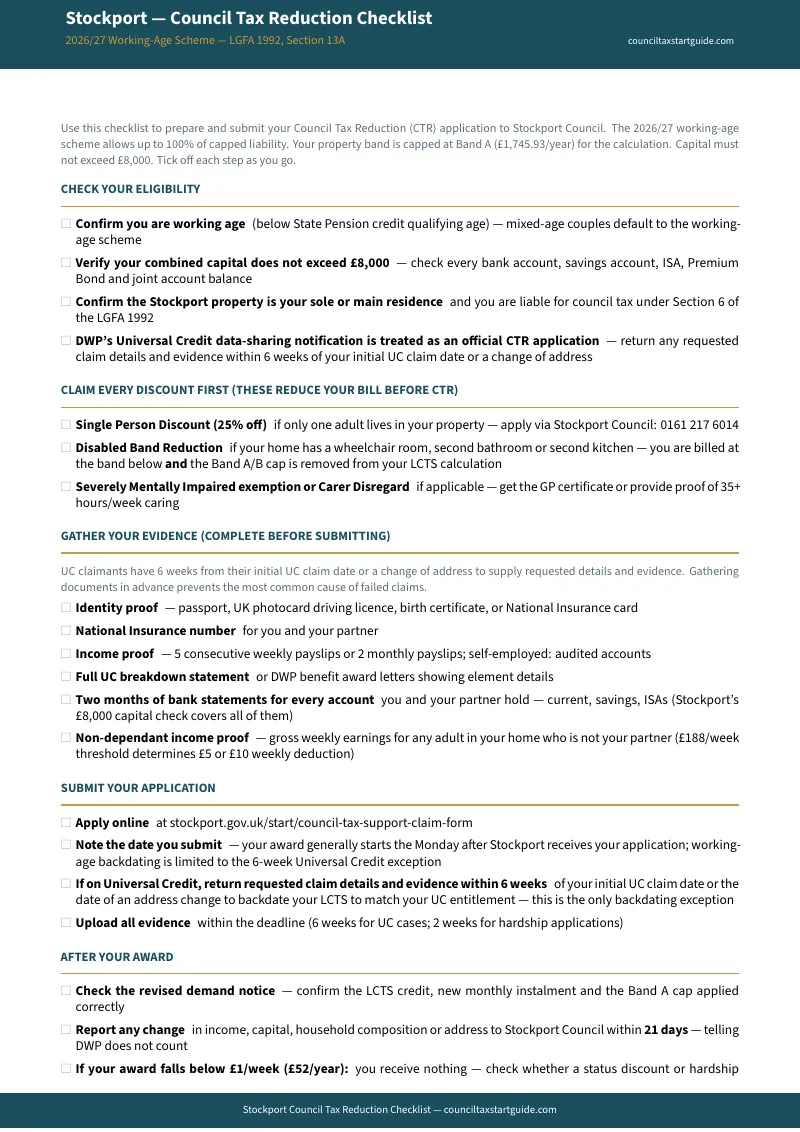
Your download includes the complete guide (55 pages, 14 chapters), a 21-item pre-application checklist, and seven standalone worksheets — an evidence gathering checklist, an entitlement estimator worksheet, a UC synchronisation timeline, a change of circumstances reporting log, a hardship application checklist, a discount and exemption checklist, and an appeal and review log. Nine PDFs in total. Or start with the free checklist — it covers the documents you'll need and the basic claim steps, so you can see whether the full guide is worth it before you pay.
Frequently Asked Questions
What if the rules change after I buy?
We update the guide when the rules change. Email us any time, even years later, and we'll send you the current edition free.