You know Barnet has a Council Tax Reduction scheme. You just can't work out what you'd actually get.
Barnet's working-age scheme could reduce your council tax bill by up to 70% — but even if your income is zero, you still pay a mandatory 30% minimum. If your property sits in Band D or higher, the discount is calculated on a Band C equivalent, shrinking it further. And if you're self-employed with a quiet month, the council applies a London Living Wage floor and assumes you're earning more than you are.
The rules are scattered across barnet.gov.uk, a 40-page scheme PDF, the Benefits General Form portal, and a completely separate Grant Approval website for hardship relief. Nobody brings it together in one place.
If you're on Universal Credit, there's an extra trap: UC does not cover council tax. You need to make a separate application directly to Barnet Council, and nobody tells you that until a demand notice arrives months later.
The Barnet Council Tax Claim Navigator is a step-by-step offline reference that walks you through Barnet's specific 2026/27 income-banded scheme — from checking which of the six earnings bands you fall into, through gathering the exact evidence the council needs, to submitting your application, requesting backdated support, and applying for hardship relief if the standard reduction still leaves a shortfall.
What's inside
- Six-band earnings decoder — Barnet's 2026/27 income bands explained with the discount percentages, the Band C capping rule, and three worked examples (single unemployed in Band B, couple on Universal Credit in Band D, self-employed with minimum income floor) so you can estimate your bill before you apply
- UC-to-local-claim bridge — the exact steps to go from your DWP journal to Barnet's Benefits General Form, including which pages of your UC PDF statement the council actually needs and why a basic screenshot gets rejected
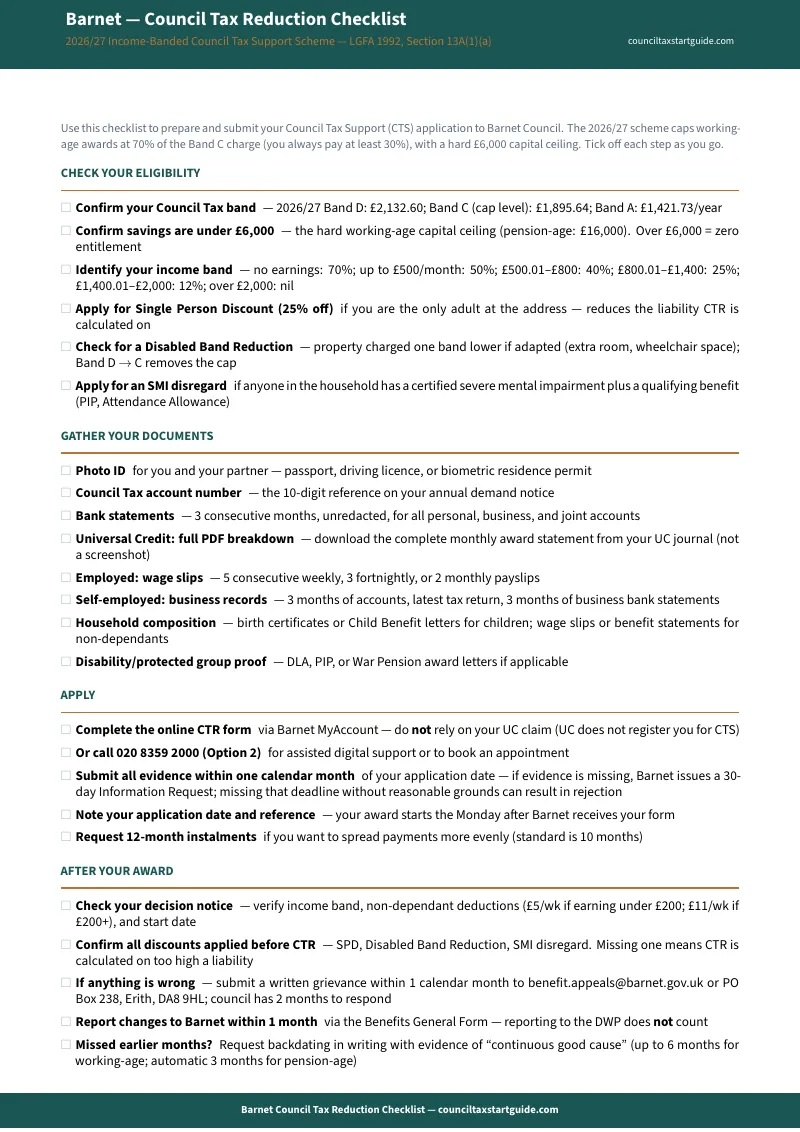
- Pre-application evidence checklist — a printable list of every document Barnet requires (three months of bank statements, full UC PDF breakdown, wage slips, capital evidence), designed to be completed before you open the portal so nothing holds up your claim
- Self-employed income floor guide — how Barnet's London Living Wage imputation works, what happens when your actual earnings fall below the floor, and what evidence can demonstrate genuine low income
- Backdating framework — the "continuous good cause" standard the council applies, a structured format for writing your backdating request, and example timelines for common delays (illness, UC transition confusion, missed awareness)
- Non-dependant deduction tables — the weekly deductions for every other adult in your household (£5/week at under £200 earnings, £11/week at £200+), plus the PIP and DLA care exemptions that can remove a deduction entirely
- CTDR hardship navigation — how to access Barnet's £500,000 Council Tax Discretionary Relief fund through the separate Grant Approval portal, what income-and-expenditure evidence to include, and the dedicated SR1 pathway for terminally ill residents
- Two-stage appeal roadmap — the mandatory internal review with Barnet's Benefit Appeals team (PO Box 238, Erith) followed by the free independent appeal at the Valuation Tribunal Service, with deadlines and what to include at each stage
- Change-of-circumstances tracker — the 21-day reporting window, what triggers a recalculation, and how to avoid overpayment recovery
Who this is for
- Working-age Barnet residents on a low income or receiving Universal Credit who want to understand exactly what the council's scheme gives them
- Self-employed residents whose actual earnings are below the London Living Wage and who want to understand how the minimum income floor affects their claim
- Households with adult children or other non-dependants who need to know how the deductions work and when exemptions apply
- Anyone who missed a claim window and wants to build a written backdating request with the right evidence
- Family members, carers and community advocates helping someone navigate the digital portals
Why not just use the council website?
You absolutely can. Barnet Council's application is free, and the guide says so on every relevant page. What the council website doesn't give you is the full picture in one place. The earnings bands are on one page. The non-dependant deductions are buried in a PDF. The backdating criteria appear somewhere else. The hardship fund sits behind a separate Grant Approval portal that isn't linked from the main CTS page. And none of it includes a worked calculation or a document assembly checklist.
The guide consolidates Barnet's specific 2026/27 scheme rules — the six income tiers, the 70% cap, the Band C capping, the £6,000 capital cut-off, the non-dependant brackets — into a single document you can read offline, print out and work through at your own pace, so you arrive at the Benefits General Form prepared.
What this guide is not
This guide is independent of Barnet Council, the DWP, the Valuation Office Agency and any government body. It is not legal advice and it is not debt advice. If you have council tax arrears, a summons, a liability order or enforcement agents at your door, the right first step is free debt advice from StepChange (0800 138 1111), National Debtline (0800 808 4000) or Citizens Advice Barnet (0808 250 5708).
Try the free checklist first
Not sure whether the full guide is worth it? Download the free Barnet Council Tax Reduction Checklist — a one-page summary of the documents and steps you need. If you want the worked calculations, the backdating framework and the hardship fund walkthrough, the full guide goes deeper.
Full refund, no time limit. If the guide isn't right for you, email [email protected].
Get the Barnet Council Tax Reduction Guide →
Frequently Asked Questions
What if the rules change after I buy?
We update the guide when the rules change. Email us any time, even years later, and we'll send you the current edition free.