You are 70, you live alone, and you are still paying the full rates bill — because nobody told you about the 20% discount you have been entitled to for years.
Northern Ireland has two non-means-tested rate allowances that could cut your domestic rates bill by 20% or 25%. The Lone Pensioner Allowance gives ratepayers aged 70 or over who live alone a 20% reduction. The Disabled Persons Allowance knocks 25% off when a property has been adapted for a disabled resident — a therapy room, an additional bathroom, essential wheelchair floor space. They can stack. They have nothing to do with your savings, pension, or income. And most people who qualify have never heard of them.
The problem is not that the allowances are hidden. Land & Property Services publishes the forms on nidirect. The problem is everything around them. The LPA form asks about "disregarded persons" but does not explain who counts. The DPA form demands proof of "additional facilities essential to meet the needs of a disabled person" without showing what passes and what does not. If you search for help, you find English council tax guidance that does not apply in Northern Ireland — there is no council tax here, the system runs on capital values and domestic rates, and the 25% single person discount that exists in England does not exist here at all.
The NI Rates Allowance Claim Workbook — the full process from eligibility check to tribunal appeal
This is not a summary of the nidirect website. It is a structured claim workbook built around the two specific problems ratepayers face: working out whether you actually qualify once the disregard rules, property tests, and tenant-versus-owner pathways are factored in — and then compiling an application strong enough that LPS does not send it back for missing evidence.
The workbook covers both allowances in one place, with separate pathways for owners (who apply to LPS directly) and tenants (who go through the Northern Ireland Housing Executive). It walks you through the full process: eligibility, evidence gathering, form completion, backdating, stacking LPA and DPA together, and challenging a refusal all the way to the Northern Ireland Valuation Tribunal.
What's inside
- Scheme Selection Diagnostic — a decision framework that routes you to LPA, DPA, or both, based on your age, household composition, and property modifications, so you never waste time on the wrong form or discover you could have claimed a second allowance after the fact.
- Resident Count and Disregard Verification Table — the full list of who counts as living with you and who does not. Non-spouse carers providing more than 35 hours of care per week are disregarded. Residents with a certified severe mental impairment are disregarded. The guide explains each category with examples, because the official form assumes you already know.
- DPA Adaptation Causality Audit — the reason most DPA claims are refused is the gap between receiving a disability benefit and meeting the property test. PIP or Attendance Allowance alone is not enough. LPS needs to see that the property contains an additional room, bathroom, kitchen, or floor area that is essential to the disabled person's needs. This worksheet helps you document each adaptation, match it to the statutory test, and avoid the rejection traps.
- Owner vs. Tenant Pathway Maps — separate, step-by-step submission routes for homeowners (LPS Application-Based Rate Relief Team, Form LPA 15.0 or DPA 16.0) and tenants (NIHE, Housing Benefit/Rates application), with the correct contact details, postal addresses, and form references for each.
- Third Party Authorisation Guide — if you are an adult child applying on behalf of an elderly parent, LPS will delay or reject the claim unless formal authority is proven. The guide covers the LPS Third Party Authorisation Form, when a Power of Attorney is required, and who must actually sign the application.
- Evidence Pre-Submission Binder — a printable checklist of every document LPS and NIHE expect for each allowance: rates bill, proof of age, pension or benefit award letters, medical certificates, occupational therapy reports, property adaptation photographs, care hours documentation, and landlord tenancy details for renters.
- Backdating Justification Template — DPA backdates to the start of the rating year the claim is received, or the adaptation date if later. LPS can exercise discretion to go further back if you can show it was unreasonable to expect an earlier claim. The guide includes a template letter for structuring that argument, with the specific factors LPS considers.
- Universal Credit Interaction Reference — the migration from legacy benefits to UC does not affect LPA or DPA, but it changes where you apply for means-tested rate support. The guide explains which schemes are still open, which have closed, and how Rate Rebate through LPS replaces Housing Benefit for working-age UC claimants — so you do not miss a concurrent entitlement.
- Refusal Escalation Pathway — a decision-tree walkthrough from the initial LPS refusal letter through a request for written reasons, internal reconsideration, and formal appeal to the Northern Ireland Valuation Tribunal, with the deadlines and procedural rules at each stage.
- Printable Worksheets — eligibility diagnostic, resident-count audit, LPA and DPA evidence checklists, application routing guide, backdating justification template, reconsideration letter template, appeal preparation checklist, and communication log, each a separate PDF designed to be printed and filled in by hand.
Who this is for
- Pensioners aged 70 or over living alone in Northern Ireland who have never claimed the Lone Pensioner Allowance — or who were refused and do not know why.
- Adult children or family members helping an elderly parent navigate the LPS forms, gather evidence, and obtain third-party authorisation to act on their behalf.
- Disabled homeowners or tenants whose property has been adapted and who want to understand what LPS actually looks for on the DPA form — beyond just having a disability benefit.
- Carers sharing a home with a pensioner who qualify as disregarded persons but do not know it, and worry that moving in will cost the household the 20% discount.
- Ratepayers who may qualify for both LPA and DPA and want to understand how the allowances stack with means-tested Rate Relief or Rate Rebate.
- Anyone whose LPA or DPA claim was refused by LPS and who wants to challenge the decision through the free official route.
Why free tools fall short
nidirect publishes the LPA and DPA application forms, and the eligibility pages are accurate as far as they go. The issue is that they describe the rules without showing you how to meet them. The LPA page says carers can be disregarded but does not walk you through proving the 35-hour threshold. The DPA form notes say an "additional facility" is required but do not explain the difference between a grab rail (which does not qualify) and a therapy room (which does). And nothing on the official site tells an adult child what legal authority they need before LPS will accept a form signed on a parent's behalf.
Advice centres like Advice NI and Age NI offer free help, but appointment waiting lists can run weeks, and the backdating window does not pause while you wait. The guide gives you the tools to build a complete application yourself — tonight — without waiting for an appointment that may not arrive in time.
What this guide is not
This is an independent process navigation guide. It has no connection to Land & Property Services, the Northern Ireland Housing Executive, the Department of Finance, or any district council. It does not guarantee any rate reduction, backdated refund, or processing timeframe. Official LPS and NIHE forms are free to download from nidirect. Capital value challenges through LPS Valuation Services are free. If you are facing enforcement action over unpaid rates, contact Advice NI (0800 915 4604), StepChange (0800 138 1111), or Citizens Advice for free debt advice immediately — this guide does not cover debt enforcement.
Full refund, no time limit
If the guide is not what you expected, email [email protected] and you will get your money back. No forms, no time limit, no questions.
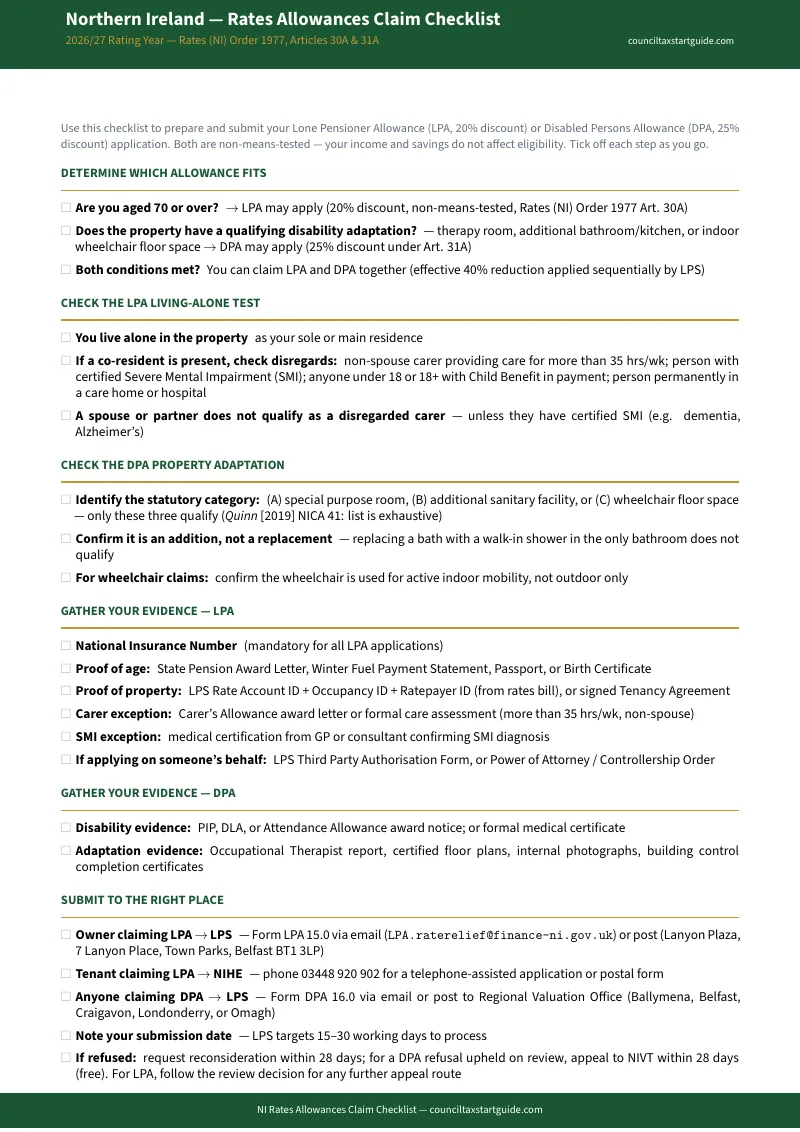
Download the free checklist to see the eligibility steps at a glance. When you are ready for the full workbook — the evidence binders, the disregard tables, the backdating template, and the appeal pathway — the complete guide is here.
Frequently Asked Questions
What if the rules change after I buy?
We update the guide when the rules change. Email us any time, even years later, and we'll send you the current edition free.