Your council has a scheme that could cut your bill. The problem is finding out how it actually works.
Every billing authority in England designs its own working-age Council Tax Reduction scheme. Some cap support at 80 per cent. Others offer up to 100 per cent. Some use income bands. Others run a traditional means test with tapers and applicable amounts. The rules on savings limits, non-dependant deductions, backdating, and protected groups differ from one council to the next — and the council's own website rarely explains any of it clearly.
You are left guessing whether you qualify, how much you might save, and whether you have the right documents to prove it. Most people either give up before they start or submit a claim with missing evidence that stalls for weeks.
The Council Tax Reduction Claim System — one framework that works with any English council's scheme
This is not a summary of generic advice you can find online. It is a structured claim system built around the reality that every council has different rules — and you need a way to decode yours, build a complete evidence pack, and submit a claim that does not bounce back.
The system works in three stages: identify your council's specific scheme rules, gather and verify every document before you open the portal, and track the claim through to a decision — with prepared fallback routes if the council refuses or delays.
What's inside
- Local Scheme Rule Finder — a diagnostic worksheet that walks you through the eleven structural variables in your council's scheme (maximum award percentage, capital limits, income bands or taper rates, band caps, non-dependant deductions, and protected group exemptions) so you know exactly what applies to your household before you claim.
- Three scheme models explained with worked examples — traditional means-tested (applicable amount + taper), income-banded, and Universal Credit-linked. Two full worked calculations — one using Rother's income-banded scheme, one using Bury's means-tested formula — show you how councils arrive at the final award figure and where the common miscalculations happen.
- Evidence Submission Audit Sheet — a verification checklist covering wage slips, unedited bank statements, self-employed income records, disability benefit award letters, and tenancy agreements. Every item is cross-referenced to the evidence rules councils actually enforce, so you upload a complete pack the first time instead of chasing missing documents against a typical one-calendar-month deadline.
- Universal Credit Cross-Check and Follow-Up Log — a dated log for claiming Council Tax Reduction alongside Universal Credit, including the separate application your council requires, the notification gap the DWP does not fill, and the UC payment changes you must report to the council.
- Backdating "Good Cause" Chronology Worksheet — a timeline worksheet for structuring a "good cause" backdating request. Covers the evidence councils accept (medical episodes, advice-seeking attempts, portal failures, administrative confusion). Where working-age backdating is allowed, local limits range from one month to six months; some schemes allow none.
- Claim Tracking Register — one place for your claim reference, submission date, evidence deadlines, decision notice, calculated award, and internal-review deadline, plus a communication log.
- Decision Notice Review Worksheet — how to read the council's written decision, check the calculation against your scheme's published rules, draft an internal review challenge, and escalate to a free appeal at the Valuation Tribunal for England if the council gets it wrong.
- VTE Appeal Preparation Worksheet — a fill-in rebuttal worksheet organised by calculation element, with the two-month and four-month deadlines, evidence checklist, and hearing format.
- Section 13A(1)(c) discretionary relief guide — how to apply for hardship relief if Council Tax Reduction still leaves you unable to pay, including what councils look for in a hardship application and what evidence strengthens a discretionary claim.
- Parallel Discount Screening Checklist — a quick-reference tool to check whether your household qualifies for other reductions (Single Person Discount, Disabled Band Reduction, Carer Disregard, Severe Mental Impairment exemption) that reduce your gross bill before CTR is calculated, increasing the effective value of your reduction.
Who this is for
- Working-age householders on a low income who have never claimed Council Tax Reduction or have been put off by confusing council websites.
- Universal Credit claimants who assumed their council tax was covered and now face arrears or an unexpected bill.
- Self-employed workers struggling with variable income and councils that demand complex proof of earnings.
- Family members or support workers helping a relative navigate the claim process.
- Anyone whose Council Tax Reduction has been refused, reduced, or delayed — and who wants to challenge the decision through the free official route.
Why free tools fall short
GOV.UK points you to your council's website. Your council's website asks you to fill in a form. Neither explains how the scheme actually calculates your award, what evidence gets claims rejected, or how to backdate beyond one month. Benefit calculators like Turn2us and entitledto give you an estimate — but an estimate is not an evidence pack, a backdating argument, or a tribunal rebuttal statement.
Citizens Advice provides excellent general guidance, but appointment backlogs mean you may wait weeks for help. In the meantime, the evidence deadline your council set — typically one calendar month — is ticking. This guide gives you the tools to organise a claim yourself, now, without waiting for an appointment that may not come in time.
What this guide is not
This is an independent process navigation guide. It has no connection to any council, HM Government, the DWP, the Valuation Office Agency, or the Valuation Tribunal for England. It does not guarantee any reduction amount, backdated award, or processing timeframe. Official claims through your council are free. Band challenges through the VOA are free. Tribunal appeals through the VTE are free. If you have active arrears, a court summons, a liability order, or bailiff enforcement, contact StepChange, National Debtline, or Citizens Advice for free regulated debt advice immediately — this guide does not cover debt enforcement.
Full refund, no time limit
If the guide does not help, email [email protected] for a full refund. No time limit, no questions.
Start with the free checklist or get the full Claim System
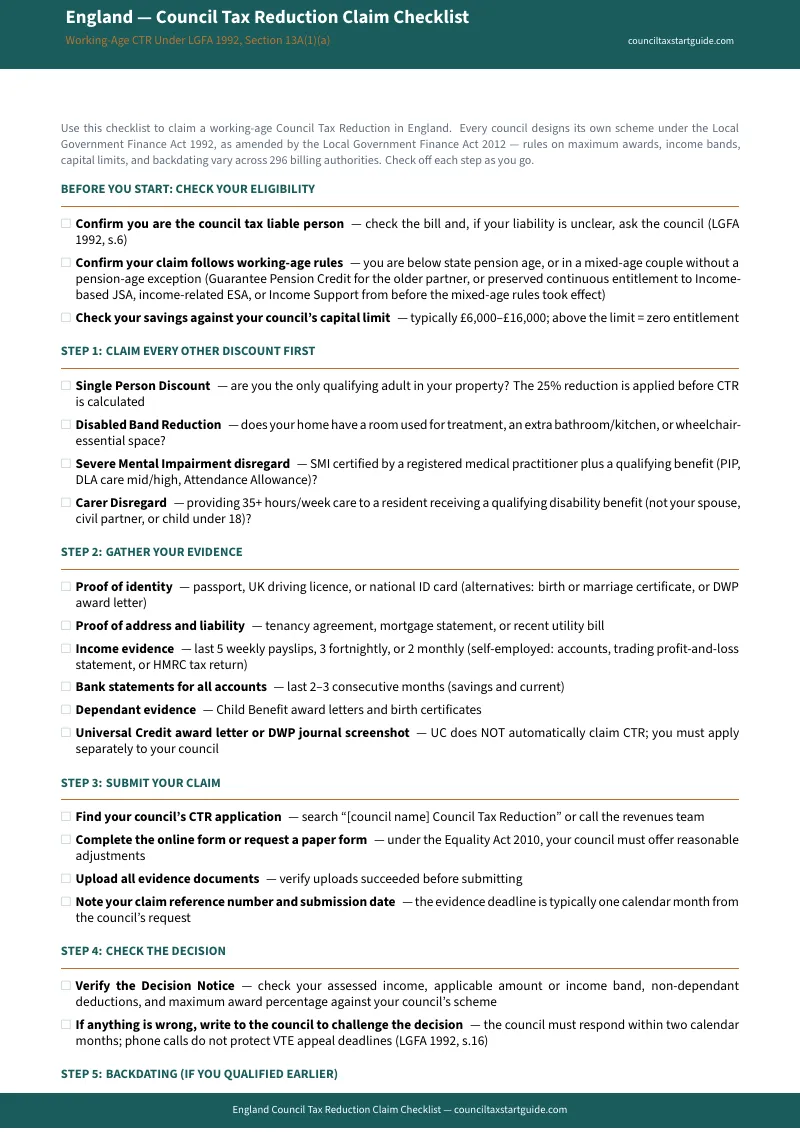
Download the England Council Tax Reduction Claim Checklist for a quick eligibility self-check, essential document list, and Universal Credit warning — free, no obligation. Ready for the complete framework? Get the full Council Tax Reduction Claim System with worked examples, backdating tools, appeal worksheets, and the discount screening checklist — everything you need to submit a decision-ready claim to any English council.
Frequently Asked Questions
What if the rules change after I buy?
We update the guide when the rules change. Email us any time, even years later, and we'll send you the current edition free.