Your Rates Bill Went Up Again. You Might Be Leaving Hundreds on the Table.
You opened the rates notice in July and the number was higher than last year. You've heard there's some kind of rebate for people on lower incomes, but the government website gives you a formula, a threshold, and a PDF form — and somehow none of it connects. Do you include water charges? What about your partner's Super? Does a SuperGold Card actually change anything? Your council's page says to "contact us for more information," and the hold music hasn't changed in twenty minutes.
Meanwhile your neighbour — who earns about the same as you — got $790 off her first quarterly instalment last year. She mentioned something about a deadline in June. You're not sure if you've missed it. You're not sure what documents you need. And you definitely don't know that the Department of Internal Affairs has a separate scheme from your council's own hardship remission, or that rates postponement is available but carries compounding interest that could cost your family tens of thousands.
The Rates Relief Navigation System maps all three pathways — the national DIA rebate, your council's discretionary remissions, and rates postponement — into a single structured toolkit with step-by-step checklists, worked calculations, and printable planning worksheets. It covers the parts that government websites, council brochures, and Age Concern factsheets leave out: how to align your income evidence to the correct tax year, how to include water and regional charges that many applicants miss, how retirement village residents can claim through the Licence to Occupy pathway, and how to calculate whether rates postponement protects your lifestyle or quietly erodes your family's inheritance.
What's Inside the Guide
The Three-Pathway Rate Relief Map
Most New Zealand homeowners know about one form of rates help — if they know about any at all. There are actually three distinct mechanisms, each with its own application, eligibility rules, and deadline. The national rates rebate is a central government subsidy of up to $830 for 2026/27. Council rates remission is a local discretionary discount for financial hardship. Rates postponement is a formal deferral that registers a statutory land charge against your property. The guide maps all three pathways in order of priority, explains where they overlap, and shows you how to combine them — a homeowner who receives the national rebate can also apply for a local remission on the remaining balance.
The Income and Document Aggregation Organiser
The most common application mistake is gathering income evidence for the wrong year. The 2026/27 rating year assesses your gross household income from the tax year ended 31 March 2026 — not the current calendar year. The organiser is structured around that exact period and walks you through every income source the council may ask for: IRD Summary of Income, NZ Superannuation and Work and Income benefits, bank interest and dividend certificates, net business profit, overseas pensions, and your partner's income from all sources. It also covers what is excluded from the calculation — Disability Allowance, Accommodation Supplement, Family Tax Credit, and war disablement pensions — so you don't over-declare and reduce your rebate unnecessarily.
The SuperGold Card Threshold Explained
Holding a SuperGold Card does not give you an automatic rebate. What it does is raise the income threshold from $33,210 to $46,400 — meaning a pensioner couple on NZ Superannuation of $42,800 may still qualify for a substantial rebate where a standard applicant on the same income would get nothing. The guide explains the higher threshold, walks through the partial abatement formula with worked examples, and shows exactly where the taper cuts your rebate to zero.
The Retirement Village LTO Workflow
Retirement village residents under a Licence to Occupy agreement are legally eligible for the rates rebate under Section 7A of the Rates Rebate Act 1973 — but many assume they cannot claim because the village operator, not the resident, is listed as the ratepayer on the Rating Information Database. You need a signed Retirement Village Resident Rates Rebate Certificate from your village manager before you can apply. The guide includes a step-by-step communication workflow, a cover letter template for requesting the certificate, and a checklist of the evidence you need alongside it — including how to extract your share of rates from the monthly village levy.
The Water Rate Inclusion Guide — Council by Council
Your total eligible rates include water and wastewater charges, but how to include them varies by council. Auckland ratepayers can add Watercare charges; former Papakura residents need a separate Veolia statement for the specific billing period. Selwyn District Council automatically integrates Selwyn Water data without a separate invoice. The guide covers the water-rate inclusion rules for the major metro and regional councils so you don't leave eligible charges off your application.
The Rates Postponement Decision Worksheet
Rates postponement lets homeowners aged 65 and over defer their rates bill against their property. It sounds like free money — but it is not. The deferred balance accrues interest at the council's borrowing rate plus administration fees, initial application or facilitation fees, and reserve fund charges. A ratepayer deferring $3,200 per year at typical rates accumulates roughly $44,700 in combined deferred rates and interest over a decade. That balance becomes a statutory land charge against the title, repayable on sale, permanent departure, or death — reducing the equity available to the estate. The decision worksheet walks you through 10 diagnostic questions covering mortgage consent, equity thresholds, fee structures, and inheritance impact so you can make the decision with numbers, not assumptions.
Council Hardship Remission Screening
Every territorial authority in New Zealand sets its own rates remission policy under the Local Government Act 2002. Some councils offer relief for extreme financial hardship. Others have specific policies for conservation land, natural disasters, or community organisations. If you missed the national rebate deadline, or your income is just above the threshold, a hardship remission may still reduce your bill — but you have to know your council's policy exists and apply for it separately. The guide includes a screening framework for identifying whether your council offers discretionary relief and how to request it.
Disputes, Reviews, and the Ombudsman
If your council refuses your rebate application or miscalculates the amount, you have recourse. The guide covers the internal review process, how to request the council's calculation workings under the Official Information Act, and how to escalate to the Office of the Ombudsman — the independent authority that investigates complaints against government agencies. It includes a timeline tracker and a summary of the precedent cases that define how councils must apply the statutory formula.
Who This Guide Is For
- Pensioners on NZ Superannuation or a limited income who want to know exactly what they qualify for and how to apply correctly the first time
- Adult children helping an elderly parent navigate the rates rebate process — especially when the parent is in a retirement village, has multiple income sources, or struggles with paperwork
- Low-income homeowners and working families who assume the rebate is only for pensioners and don't realise that wage earners meeting the income and rates thresholds are fully eligible
- Retirement village residents under a Licence to Occupy who need the village manager's certificate and don't know where to start
- Homeowners over 65 considering rates postponement who want to understand the true cost before signing up — including the compounding interest, fees, and equity impact on the estate
- Anyone whose council has refused a rebate, calculated an unexpectedly low amount, or failed to respond within a reasonable timeframe
Why Not Just Use the Free Resources?
The government website, your council, and Citizens Advice Bureau all provide free information on rates rebates. If your situation is straightforward — single income, own home, no retirement village, no water-charge complications — those free routes may be all you need. The official forms are free, the calculator on govt.nz is free, and CAB volunteers will help you fill in the paperwork at no charge.
- Govt.nz provides the official thresholds, forms, and a calculator. It does not help you organise income from multiple sources across the correct tax year, explain how partial abatement works above the threshold, or cover council-level differences in water charge inclusion and processing times.
- Your council's website explains its own process. It does not cover the national scheme's formula in detail, compare remission and postponement options, or tell you what to do when the council miscalculates your rebate. Each of New Zealand's 67 territorial authorities handles the process differently — some take online applications, others require a witnessed statutory declaration in person.
- Citizens Advice Bureau offers free in-person help. CAB is excellent for face-to-face support, but branch hours vary, appointments can take weeks, and the assistance covers the form — not the income-organisation, backdating strategy, or dispute resolution that the guide provides.
- Age Concern and MoneyTalks provide referrals and budgeting support. They focus on broader financial wellbeing, not the operational detail of rates rebate applications, retirement village certification, or postponement equity analysis.
Free resources explain what the rebate is. This guide gives you the tools to claim it correctly, include every eligible charge, and understand your options when the straightforward route doesn't cover your situation.
— A Fraction of One Year's Rebate
The maximum rates rebate for 2026/27 is $830. Many eligible homeowners claim nothing because they don't realise they qualify or because they gather the wrong documents. A missed deadline means the entire year's rebate is gone — the scheme does not allow backdating. The guide costs less than one quarterly rates instalment on most New Zealand properties, and a successful rebate claim pays for it many times over.
Your download includes 8 printable PDFs:
- Rates Rebates in New Zealand Guide (45 pages) — the complete rates relief system: eligibility rules, the rebate formula with worked examples, the SuperGold Card threshold, retirement village LTO pathway, application channels and evidence requirements, deadlines and renewal, trusts and estates, council remissions, rates postponement with 10-year equity modelling, and disputes and the Ombudsman
- Income and Document Aggregation Organiser — fill-in income ledger aligned to the correct tax year, with applicant and partner sections and an excluded-income reference
- Retirement Village LTO Workflow Sheet — step-by-step village manager certificate request tracker with cover letter template
- Water Rate Inclusion Checklist — council-by-council water charge rules and eligible charge compilation form
- Renewal Calendar and Receipt Log — annual application tracker covering eight rating years
- Rates Postponement Decision Worksheet — 10 diagnostic questions with 5-year and 10-year equity projections
- Council Hardship Remission Screening Matrix — discretionary remission category screening for your council
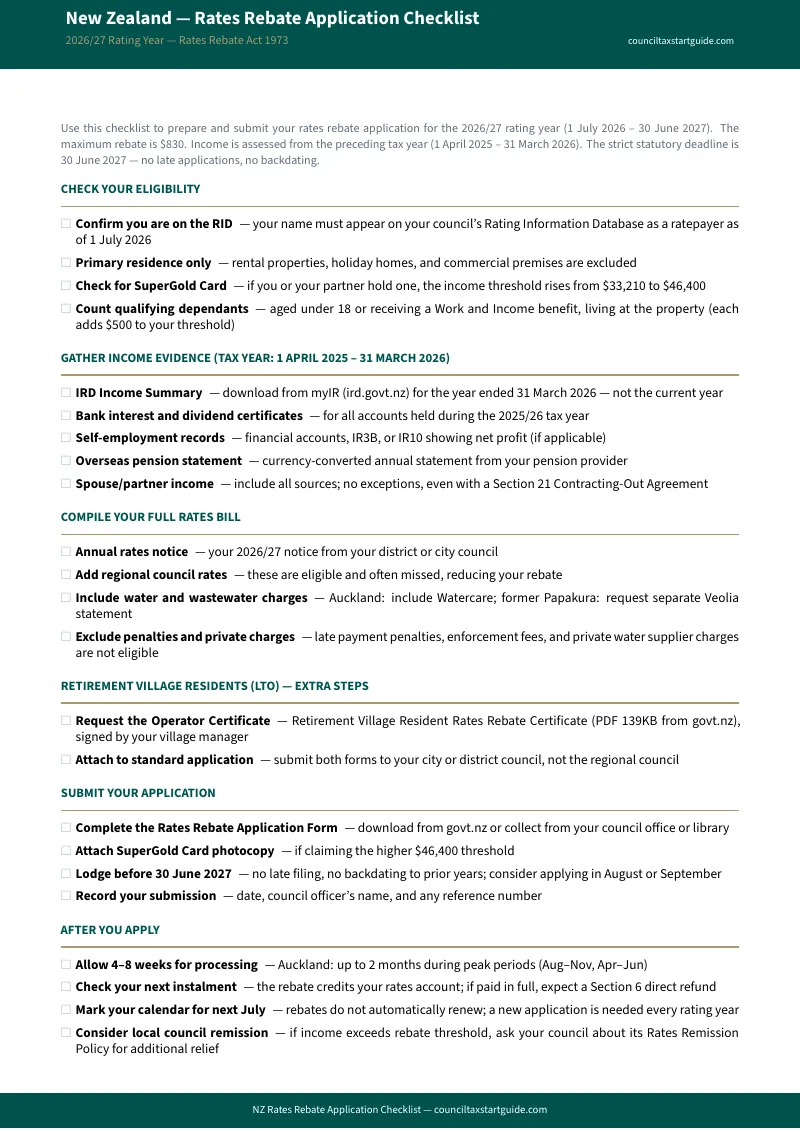
- New Zealand Rates Rebate Application Checklist (free) — 24-item checklist covering eligibility, income evidence, rates compilation, retirement village steps, application submission, and post-application follow-up
Instant PDF download. Start your application tonight.
Full refund, no time limit. If this guide does not help you navigate the rates rebate process, email [email protected] for a full refund. No questions asked.
Not ready for the full guide? Download the free New Zealand Rates Rebate Application Checklist — a 24-item checklist of the eligibility conditions, documents, and steps. It tells you what to gather and in what order. The full guide tells you how to calculate your rebate, navigate the retirement village pathway, evaluate rates postponement, and challenge a council decision.
The application deadline is 30 June 2027. Every month you wait is a month closer to losing this year's rebate entirely.
Frequently Asked Questions
What if the rules change after I buy?
We update the guide when the rules change. Email us any time, even years later, and we'll send you the current edition free.