Your Council Tax Bill Just Tripled. Here's How to Get the Premium Removed.
You opened the annual demand notice and the number made no sense. The Band D bill on a property that used to cost £2,000 a year now reads £5,000 — or £8,000. Your council has applied a second home premium, or a long-term empty premium, at anything up to 300%. The letter does not explain why it chose that percentage, which exceptions might apply, what evidence you would need, or how to challenge the decision if you disagree.
You searched online. gov.wales gave you a list of seven exception classes and a link to the 2015 regulations. Your council's website showed you the current premium rate and a basic claim form. Neither explained how to prove your asking price is "reasonable" when the council says it is too high, how to defend a self-catering holiday let that fell short of the 182-day letting threshold, how the six-week anti-avoidance rule resets the empty property clock, or how to escalate a refusal to the Valuation Tribunal for Wales — free, independent, and binding on the council.
The Wales Premium Exception and Evidence System is a structured toolkit that walks you through the entire framework — from identifying which statutory exception or dwelling exemption applies to your property, through the evidence your council actually wants and the application process, to the formal Section 16 grievance and VTW appeal route if the council refuses. It covers the parts that council websites, gov.wales, Citizens Advice, and Age Cymru leave out: the evidence assembly standards that stop applications being rejected, the self-catering threshold calculations that determine whether your holiday let stays on business rates, the backdating rules for refunds, and the escalation timeline when the council says no.
What's Inside the Guide
The Premium Framework — Which Category Your Property Falls Into
Welsh councils can charge premiums on two categories: second homes (substantially furnished, not anyone's sole or main residence — premium from day one under Section 12B) and long-term empty dwellings (unoccupied and substantially unfurnished for at least 12 months — premium under Section 12A). The guide explains the legal tests for each, the six-week anti-avoidance rule that prevents brief occupancy from resetting the empty property clock, and a property status classifier that maps your situation to the correct premium category before you read any further.
The Seven Statutory Exception Classes — With Evidence Checklists
Welsh law creates seven national exception classes (Classes 1–7) that remove the premium while leaving the base council tax in place. Class 1 protects properties being marketed for sale at a reasonable price. Class 2 protects properties marketed for let. Class 3 covers annexes forming part of a main dwelling. Class 6 protects properties where planning conditions prohibit year-round occupancy — the 2023 amendment that affects hundreds of holiday lets. Class 7 covers job-related dwellings where your employer requires you to live elsewhere. Each exception has its own evidence requirements, time limits, and re-use restrictions. The guide details every class with an evidence assembly checklist so you submit once with everything your council needs.
Self-Catering Holiday Let Thresholds — the 252/182 Day Calculation
A self-catering property in Wales must be available for commercial let for at least 252 days and actually let for at least 182 days in any 12-month period to qualify for business rates instead of domestic council tax. These thresholds were raised from 140/70 in April 2023, and the VOA actively audits compliance via Form VO6048. If your property fails the test, it is reclassified to domestic council tax and immediately attracts a second home premium — unless protected by Class 6 planning restrictions. The guide includes a letting days log and the new multi-year averaging provisions from April 2026, so you can check your position before the VOA does.
Full Dwelling Exemptions — When You Pay Nothing at All
Separately from the premium exceptions, several dwelling exemptions can eliminate the council tax charge entirely. Class C gives six months of exemption when a property first becomes empty and unfurnished. Class A covers properties undergoing major structural repairs for up to 12 months — a provision Wales retained when England abolished it in 2013. Class E and J exempt properties left empty when the owner moves permanently into a care home or hospital. Class F covers a property left empty after the owner's death, for up to six months after probate is granted. The guide explains how these exemptions interact with the premium timeline and what happens when they expire.
The Section 16 Grievance and VTW Appeal Route
If your council refuses an exception application or fails to respond within two months, you have a statutory right to appeal to the Valuation Tribunal for Wales under Section 16 of the Local Government Finance Act 1992. The appeal is completely free — no fee, no solicitor required. The guide includes an application timeline tracker that records your submission date, the council's two-month response deadline, and the appeal window. It walks you through the written grievance, the VTW appeal form, the evidence bundle, and what to expect at the hearing.
Local Discretionary Exceptions Across Wales — 2026/27
Beyond the seven national classes, some councils operate their own local exceptions. Newport's Local Exception A covers annexes not qualifying under Class 3. Merthyr Tydfil's Classes 8 and 9 cover new-owner transitions and properties undergoing renovation. The guide maps local policies across Welsh councils for the current tax year, so you do not miss a locally-available exemption that your council's website barely mentions.
Who This Guide Is For
- Owners of second homes in Wales who have received a premium demand and need to identify which exception applies — or whether one applies at all
- Owners of long-term empty properties — inherited houses waiting for probate or sale, homes being renovated, properties left vacant after a move into care — facing premiums of 100% to 300%
- Self-catering holiday let operators in Wales who need to check whether they meet the 252/182-day thresholds or risk reclassification to domestic council tax with an immediate second home premium
- Landlords between tenants whose furnished rental void has triggered second home premium status from day one of vacancy
- People required to maintain a second home for work (job-related dwelling) who are paying double council tax across two authorities
- Family members managing council tax for an elderly relative who has moved into residential care, or executors handling a property during probate
- Anyone whose council has refused a premium exception and who needs to challenge the decision through the formal grievance and appeal route
Why Not Just Use the Free Resources?
gov.wales, Citizens Advice Cymru, Age Cymru, and your council's website all publish useful introductory guidance on premium rules. None of them give you the structured tools to handle the parts of the application that actually go wrong.
- gov.wales defines the seven exception classes. It does not explain how to assemble an evidence package that satisfies your council's audit requirements, how to defend a Class 1 "reasonable price" challenge, or what to do when your council refuses the application with a one-line letter.
- Your council's website shows the premium rate and a basic application form. It does not provide an evidence assembly checklist, a self-catering letting days log, or any guidance on transitioning from a dwelling exemption (Class C, Class A) to a premium exception when the exemption expires.
- Citizens Advice Cymru helps people facing arrears and enforcement. It does not provide structured exception application workflows or appeal templates for property owners contesting premiums.
- Age Cymru Factsheet 21w covers standard discounts, exemptions, and reductions. It does not address the statutory premium exception classes, the self-catering thresholds, or the VTW appeal process for premium refusals.
- Band-challenge firms handle VOA valuation proposals and take 30%–40% plus VAT of any refund. Valuation band challenges are a completely separate process from premium exceptions. The official application route for both premium exceptions and VTW appeals is free. This guide shows you how to use it.
Free resources explain that premiums and exceptions exist. This guide gives you the evidence checklists, threshold calculations, and escalation tools to apply for an exception, defend your position, and appeal a refusal — through the free official route.
— A Fraction of One Year's Premium
A 100% premium on a Band D property in Wales adds over £2,000 a year. At 150%, the premium alone exceeds £3,000. At 300%, it exceeds £6,000. If your property legitimately qualifies for an exception, a single successful application removes the premium for as long as the exception conditions are met. This guide costs less than a day's worth of the premium it helps you challenge.
Your download includes 8 PDFs, instant download:
- Second Home and Empty Home Council Tax Premiums in Wales: Exceptions Guide (47 pages) — the full premium framework for 2026/27, all seven statutory exception classes with evidence requirements, self-catering holiday let thresholds with the 2023 changes and 2026 averaging provisions, full dwelling exemptions, the application process, Section 16 grievance and VTW appeal route, five worked scenarios, calculation examples, and six planning worksheets
- Property Status Classifier — work through the checklist questions to confirm whether your property falls into the second home or long-term empty category, which exception classes may apply, and the self-catering threshold check
- Evidence Assembly Checklist — tick off every document your council needs for the specific exception class you are claiming, from estate agent agreements (Class 1) to planning decision notices (Class 6)
- Premium Calculation Worksheet — calculate your total liability, the annual saving from a successful exception claim, and the backdated refund you are owed
- Application Timeline Tracker — record milestones from initial application through Section 16 grievance and VTW appeal, with deadline alerts
- Agency Communication Log — log every contact with your council (date, method, officer, outcome) so you have a documented record for escalation
- Self-Catering Letting Days Log — track available and let days month by month against the 252/182-day thresholds, with multi-year averaging and VOA audit preparation
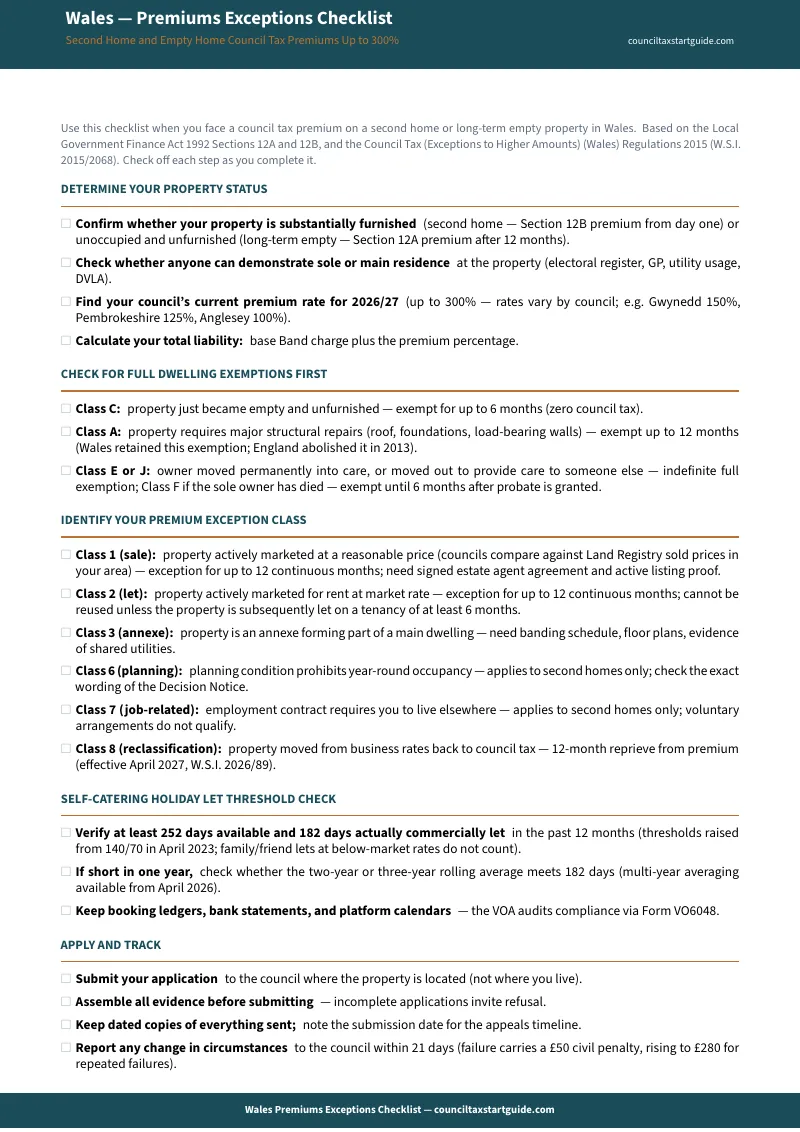
- Wales Premiums Exceptions Checklist (free, 2 pages, 25 items) — property status check, exception and exemption checklist, self-catering threshold quick-check, and the appeal timeline
Instant PDF download. Start your exception claim tonight.
Full refund, no time limit. If this guide does not help you navigate the premium exception process, email [email protected] for a full refund. No questions asked.
Not ready for the full guide? Download the free Wales Premiums Exceptions Checklist — a 25-item, 2-page checklist of the premium rules, exception classes, evidence to gather, and the appeal route. It tells you what to do and in what order. The full guide tells you how — with the evidence checklists, threshold calculations, and escalation tools that make the difference between a refused application and a successful exception claim.
The premium on your property could be removed — through a free, official process. This guide shows you how to use it.
Frequently Asked Questions
What if the rules change after I buy?
We update the guide when the rules change. Email us any time, even years later, and we'll send you the current edition free.