Your Council Tax Bill Doubled. The Council's Letter Doesn't Explain How to Get It Reduced.
You opened the demand notice and the number had changed. The Band D charge on a property that nobody lives in now reads double or triple what it was last year. Your council has applied a second home premium, or a long-term empty premium, under powers that became uncapped on 1 April 2026. The letter does not explain which category your property falls into, which of the exemptions or exceptions might remove the charge, what evidence the revenues department actually wants, or how to challenge the decision through the free tribunal route if the council says no.
You looked online. mygov.scot listed the basic categories and a link to the 2013 regulations. Your council's website showed you the premium rate and a form. Neither explained how to prove you meet the 25-day occupancy threshold that separates a second home from a long-term empty property, how to build the evidence package that secures a marketing or renovation exception instead of a one-line refusal, how the six-week anti-avoidance rule prevents a quick weekend stay from resetting the empty-property clock, or how to escalate a refusal to the Local Taxation Chamber — free, independent, and binding on the council.
The Scottish Exception and Evidence System is a structured toolkit that walks you through the entire framework — from confirming which statutory category your property falls into, through the exemptions that remove council tax entirely and the premium exceptions that drop the surcharge back to the standard rate, to the evidence your council needs and the formal appeal route when the council refuses. It covers the parts that council websites, mygov.scot, Citizens Advice Scotland, and the Scottish Empty Homes Partnership leave out: the evidence assembly standards that stop applications being rejected, the holiday let threshold calculations that determine whether your property stays on Non-Domestic Rates, the anti-avoidance rules that catch owners off guard, and the step-by-step appeal timeline when the council says no.
What's Inside the Guide
The Three-Category Classification — Where Your Property Sits
Scottish councils classify unoccupied properties into three categories: second homes (substantially furnished, occupied 25+ days a year, nobody's sole or main residence), short-term unoccupied dwellings (under 12 months empty), and long-term empty homes (continuously unoccupied for over 12 months). Each category carries different premium powers and different available exceptions. The guide includes a property status classifier that maps your specific situation — inherited house, renovation project, property for sale, job-related home — to the correct statutory category before you read any further.
Full Exemptions — When You Pay Nothing at All
Several statutory exemptions can eliminate the council tax charge entirely on an empty property. Class A covers properties undergoing major structural repair — the building warrant, not a trade quote, is the evidence threshold. Class E covers properties left empty because the owner moved permanently into residential care. Class F covers properties held by executors until six months after Confirmation is granted by the Sheriff Court. Class G covers properties where occupation is prohibited by law. The guide explains each exemption's evidence requirements, time limits, and what happens when the exemption period expires and the premium clock starts.
Premium Exceptions — Keeping the Charge at the Standard Rate
Separately from the zero-tax exemptions, several discretionary exceptions remove the premium surcharge while keeping the base council tax in place. Active marketing for sale or let (up to 24 months, with evidence of realistic pricing and genuine marketing activity). New owner renovation (mandatory 6-month grace period from 1 April 2024, with council discretion to extend). Job-related accommodation (mandatory 50% discount, no premium, where your employment contract requires you to live elsewhere). Each exception has its own evidence checklist — the guide maps every one against the exact documents your council's revenues department needs.
Holiday Let NDR Boundary — The 70-Day Calculation
A self-catering property in Scotland must be available for commercial let for at least 140 days and actually let for at least 70 days in the financial year to qualify for Non-Domestic Rates instead of council tax. If the property fails the 70-day test, it falls back to domestic council tax and is immediately classified as a second home or empty property — attracting whatever premium your council has set. The guide includes a letting days tracker so you can check your position against both thresholds before the Assessor does, with the evidence trail that survives an NDR audit.
The Evidence Assembly System
Council revenues departments reject applications when the supporting evidence is incomplete, informally assembled, or missing the specific documents the exception requires. An estate agent agreement alone does not prove active marketing — the council wants the home report, portal listing screenshots, and a log of any price reductions. A contractor invoice does not prove structural repair — the council wants the building warrant and a photographic timeline. The guide provides an evidence matrix mapping every exemption and exception to the exact documents required, so you submit once with everything the council needs.
The Local Taxation Chamber Appeal Route
If your council refuses an exception application, or fails to respond within two months of your formal written grievance under Section 81, you can appeal to the First-tier Tribunal for Scotland (Local Taxation Chamber) at Bothwell House, Hamilton. The appeal is completely free. The guide walks you through the three-stage process — initial grievance, council response window, and LTC appeal — with a timeline tracker recording deadlines, submission dates, and the council officer you dealt with. Council tax must continue to be paid during the appeal.
Who This Guide Is For
- Owners of second homes in Scotland who have received a premium demand and need to identify which exception — marketing, renovation, job-related — applies to their situation
- Owners of long-term empty properties — inherited houses waiting for Confirmation or sale, homes undergoing structural repairs, properties left vacant after a move into care — facing premiums of 100% to 500%
- Self-catering holiday let operators who need to check whether they meet the 140/70-day thresholds or risk automatic reclassification to domestic council tax with an immediate second home premium
- Landlords between tenants whose furnished rental void has triggered second home status from day one of vacancy
- People required to maintain a second home for work who are paying council tax on two properties across two authorities
- Family members managing council tax for a relative who has moved into residential care, or executors handling a property during the Confirmation period
- Anyone whose council has refused a premium exception and who needs to challenge the decision through the formal grievance and Local Taxation Chamber appeal route
Why Not Just Use the Free Resources?
mygov.scot, Citizens Advice Scotland, your council's website, and the Scottish Empty Homes Partnership all publish useful introductory guidance on premium rules. None of them give you the structured tools to handle the parts of the application that actually go wrong.
- mygov.scot defines the basic categories and discount types. It does not explain how to assemble an evidence package that satisfies your council's audit requirements, how to defend a marketing exception when the council disputes your asking price, or what to do when your council refuses the application with a one-line letter.
- Your council's website shows the premium rate and a basic claim form. It does not provide an evidence assembly checklist, a holiday let letting days tracker, or any guidance on transitioning from a full exemption (Class A structural repair) to a premium exception when the exemption period expires.
- Citizens Advice Scotland helps people facing arrears and enforcement. It does not provide structured exception application workflows, evidence matrices, or appeal templates for property owners contesting premiums on second or empty homes.
- The Scottish Empty Homes Partnership helps owners bring properties back into use. Empty Homes Officers are council employees or affiliated officers — they do not represent owners in tax liability disputes or prepare tribunal submissions.
- Band-challenge firms handle Assessor proposals and take 25%–30% plus VAT of backdated refunds. Band challenges are a completely separate process from premium exceptions. The official application route for both premium exceptions and LTC appeals is free. This guide shows you how to use it.
Free resources explain that premiums and exceptions exist. This guide gives you the evidence checklists, threshold calculations, and appeal tools to apply for an exception, defend your position, and challenge a refusal — through the free official route.
— A Fraction of One Year's Premium
A 100% premium on a Band D property in Scotland adds over £1,500 a year. At 200%, the premium alone exceeds £3,000. At 500%, it exceeds £7,500. If your property legitimately qualifies for an exception, a single successful application removes the premium for as long as the exception conditions are met. This guide costs less than a single day's worth of the premium it helps you challenge.
Your download includes 9 PDFs, instant download:
- Second Homes and Empty Homes Council Tax in Scotland: Charges, Discounts and Exceptions (49 pages) — the full premium framework for 2026/27, the three-category classification system, statutory exemptions (Class A/E/F/G), premium exceptions (marketing, letting, renovation, job-related), holiday let NDR boundary with the 140/70-day thresholds, anti-avoidance rules, the 25-day occupancy test, application procedures for all 32 councils, the three-stage appeal process (grievance → response window → Local Taxation Chamber), worked premium calculations, and evidence assembly system
- Classification Flowchart — walk through the statutory tests (furnished status, 25-day threshold, 12-month clock, exemptions, exceptions) to confirm your property's category before you apply for anything
- Premium Calculation Worksheet — calculate your total liability step by step, verify it against your actual bill, and work out the annual saving from a successful exception
- Evidence Checklist by Claim Type — tick-list of every document required for each claim category, from building warrants to estate agent agreements
- Property Chronology Worksheet — date-stamped timeline of every status change, council communication, and occupancy period
- Section 81 Grievance Preparation Checklist — structured preparation sheet for your formal written grievance, with statutory basis, evidence tracking, and submission record
- Appeal Deadline Tracker — all three appeal stages plus band disputes and penalty appeals, with deadlines calculated from your dates
- Holiday Let Threshold Log — monthly tracking of availability and actual letting nights against the 140/70-day thresholds, with booking evidence for the Assessor's SCU declaration
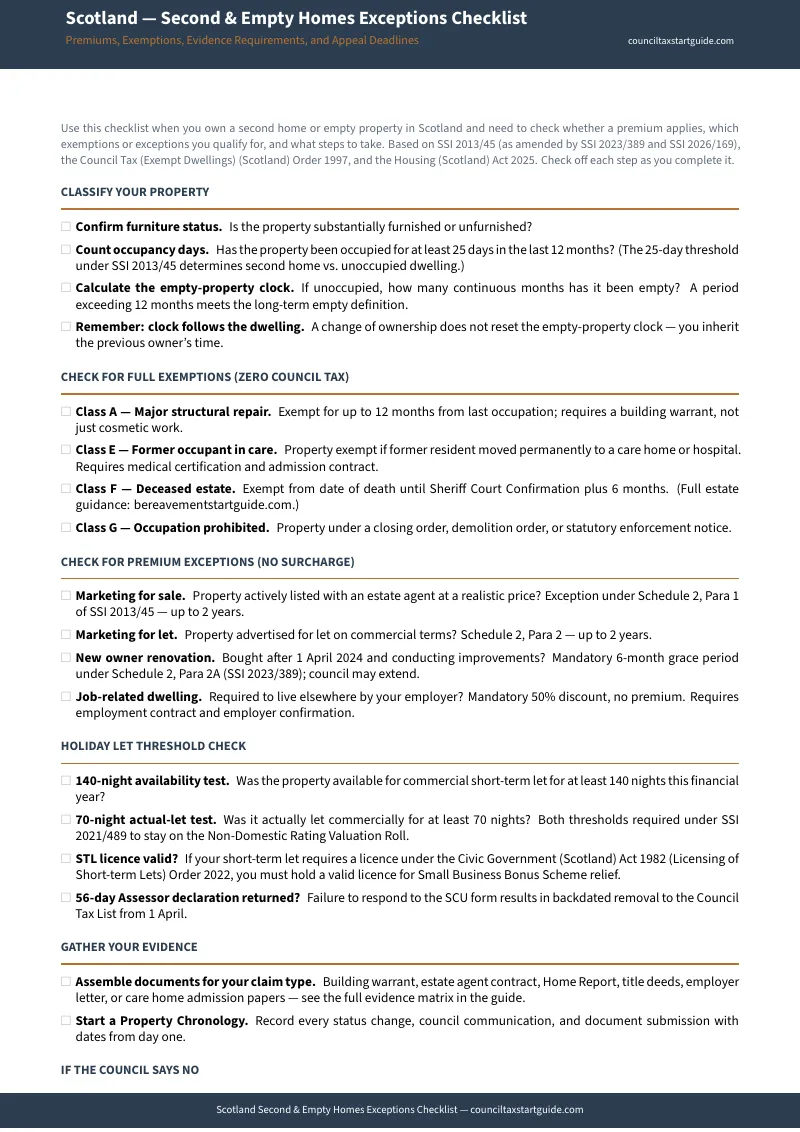
- Scotland Second & Empty Homes Exceptions Checklist (free, 2 pages, 23 items) — property status classifier, exemption and exception checklist, holiday let threshold quick-check, evidence summary, and appeal timeline
Instant PDF download. Start your exception claim tonight.
Full refund, no time limit. If this guide does not help you navigate the premium exception process, email [email protected] for a full refund. No questions asked.
Not ready for the full guide? Download the free Scotland Second & Empty Homes Exceptions Checklist — a 23-item, 2-page checklist of the premium rules, exemptions, exceptions, evidence to gather, and the appeal route. It tells you what to do and in what order. The full guide tells you how — with the evidence checklists, threshold calculations, and escalation tools that make the difference between a refused application and a successful exception claim.
The premium on your property could be removed — through a free, official process. This guide shows you how to use it.
Frequently Asked Questions
What if the rules change after I buy?
We update the guide when the rules change. Email us any time, even years later, and we'll send you the current edition free.