You qualified for a council tax reduction months ago. You just didn't know it.
Universal Credit doesn't cover your council tax. The DWP won't tell you that when you apply — and Salford City Council won't chase you to claim the reduction you're owed. So the bill arrives at full rate, you panic, and by the time you find the right form on the council's website, you've already overpaid or missed weeks of backdating you could have claimed.
Salford's Council Tax Reduction scheme can cut your bill by up to 88%. But the scheme is local — the income bands, the minimum payment, the reporting rules, the hardship fund — none of it matches what you'll find on national advice sites or generic council tax guides. And the council's own pages split the information across dozens of links, leaving you to piece together which rules apply to your household.
The Salford Claim Preparation System
This guide is built around one idea: if you know exactly what Salford's scheme expects before you log into the portal, your claim goes through faster, with fewer requests for evidence, and at the right award level from day one.
It consolidates every rule that applies to working-age residents in Salford — the 2026/27 income band thresholds, the evidence requirements, the reporting obligations, the backdating criteria, the hardship fund, and the appeals process — into a single walkthrough you can follow from start to finish.
What's inside
- Salford's five income bands mapped out — the exact thresholds for singles, couples, one-child families, and larger families, so you know your award percentage (88%, 75%, 50%, 25%, or 10%) before you apply. No more guessing where your household sits.
- Income calculation worksheet — which Universal Credit components count, which are disregarded (PIP, DLA, Attendance Allowance, LCWRA, childcare element, Child Benefit), how the 45% pension disregard works, and what self-employed claimants need to know about the Minimum Income Floor.
- Evidence checklist by household type — exactly which bank statements, payslips, UC entitlement screens, and self-employed records the portal requires, organised so nothing gets rejected for missing documentation.
- Non-dependant deduction rules — the £7-per-week charge, who's exempt (under-21s, students, carers, disability benefit recipients), and how to make sure the council applies the exemption correctly.
- Backdating strategy — how "good cause" works in Salford, what counts as a valid reason for a late claim, and the automatic three-month backdate available to pension-age claimants.
- Section 13A hardship relief — when the statutory reduction still leaves you in financial difficulty, how to apply for Discretionary Council Tax Support and access the Crisis and Resilience Fund.
- 21-day change reporting guide — which earnings changes cross band boundaries, when to report, what the portal needs, and how to avoid overpayment recovery or penalties.
- Appeals from start to finish — requesting an internal review, the council's two-month response window, and escalating to the Valuation Tribunal for England at no cost.
- Discount stacking checklist — how CTR works alongside the Single Person Discount, Severe Mental Impairment exemption, Disabled Band Reduction, and other reliefs you may be entitled to claim on top.
Who it's for
- Universal Credit claimants in Salford who didn't know they need to apply for council tax support separately — and may already be months behind on a claim they're entitled to.
- Variable earners and zero-hours workers whose income moves across band thresholds and who need to understand when a shift change or overtime payment triggers a reporting obligation.
- Self-employed residents navigating the Minimum Income Floor assessment and trying to document their earnings correctly the first time.
- Family members and carers completing a claim on behalf of someone who can't manage the online portal alone — the guide is structured so a helper can work through it step by step.
- Anyone whose award looks wrong — the guide shows you how to check the council's calculation against the published thresholds and challenge it through the proper channels.
Why not just use the council's website?
The council's website is free, and this guide links to it throughout. What the council doesn't provide is a single document that ties the eligibility check, the income calculation, the evidence requirements, the backdating rules, and the reporting obligations together in order. Its pages are written for compliance — explaining what the rules are — not for navigation: showing you what to do first, what to gather, and how to avoid the mistakes that delay claims or reduce awards.
National advice sites are worse. They describe council tax reduction as if every council in England runs the same scheme. Salford's income bands, its 12% minimum payment, its £7 non-dependant deduction, its 21-day reporting window — none of that appears in a generic guide, because every council sets its own rules.
The free checklist versus the full guide
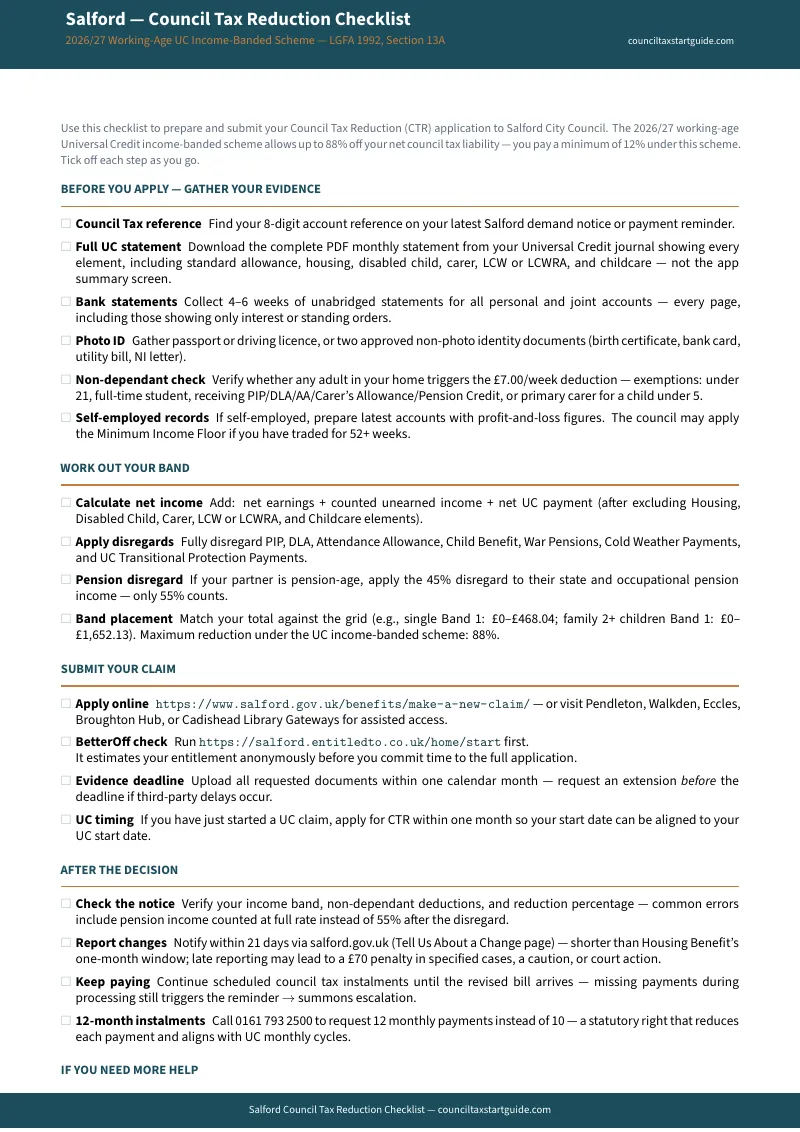
The free Salford Council Tax Reduction Checklist gives you the document inventory and the key steps — enough to know what paperwork to gather and where to submit it. The full guide goes deeper: income band calculations with worked examples, the backdating process, the hardship application, non-dependant deduction exemptions, and the complete appeals route.
If your circumstances are straightforward — stable income, no dependants, no complications — the checklist may be all you need. If your income varies, you have non-dependants in the house, you need to backdate, or you think your award is wrong, the full guide covers every scenario.
Full refund, no time limit
If the guide doesn't help, email [email protected] for a full refund. No time limit, no questions.
This guide is published by Council Tax Start Guide, an independent publisher. It is not affiliated with, endorsed by, or connected to Salford City Council, the DWP, or the Valuation Office Agency. The official application at salford.gov.uk is completely free. Purchasing this guide does not guarantee any specific award — eligibility is decided by Salford City Council under the statutory rules.
Debt and enforcement
If you've received a court summons, a liability order, or a letter from enforcement agents, do not buy this guide. Contact free, confidential debt advice immediately:
- StepChange — 0800 138 1111
- National Debtline — 0808 808 4000
- Citizens Advice Salford — 0808 278 7802
Frequently Asked Questions
What if the rules change after I buy?
We update the guide when the rules change. Email us any time, even years later, and we'll send you the current edition free.