Every council in England runs a different scheme. The bill lands on you while you work out which one.
There is no national council tax exemption for care leavers in England. Scotland and Wales wrote one into law — England did not. Instead, each of the 309 billing authorities in England decides on its own terms: who qualifies, what age limits apply, whether out-of-area care leavers are covered, and how much of the bill gets reduced. Some councils knock it to zero automatically once Children's Services confirms your status. Others require bank statements and income assessments every year. Others have no published policy at all.
Meanwhile, the Revenue and Benefits team that sends your bill may have no idea you were ever in care. Children's Services sits in one department — often a different building or an outsourced contractor — and the revenue system that generates council tax demands sits in another. Unless someone bridges that gap, the system treats you like any other tenant: bill, reminder, final notice, court summons.
The Care Leaver Council Tax Claim System gives you the administrative framework that council websites don't: a policy comparison worksheet, a Personal Adviser evidence checklist, the correct order-of-calculation sequence, cross-boundary dispute protocols, backdating templates, and a formal challenge pathway — everything you need to claim what you're owed and push back when the council gets it wrong.
What's Inside
- Council Policy Comparison Worksheet — every council's Section 13A(1)(c) care leaver scheme is different. The worksheet gives you a structured framework to extract and record the key clauses from your specific council's policy: the age boundaries, the care history threshold, whether out-of-area care leavers qualify, how mixed households are handled, and whether a means test applies. You stop guessing what your council offers and start claiming against what its own policy says.
- Personal Adviser Evidence Checklist — revenue officers reject applications when the verification letter from Children's Services is vague, missing statutory references, or unsigned by the right team. The checklist specifies exactly what a PA letter needs to contain: the statutory category (Former Relevant Child under Section 23C of the Children Act 1989), the dates of care, the originating local authority, and the officer's contact details. You hand your Personal Adviser the checklist; they produce a letter that revenue cannot reject.
- Order-of-Calculation Sequence — Section 13A(1)(c) discretionary relief is applied after every other discount. Councils reject claims when applicants skip the mandatory sequence: first, statutory exemptions (Class N for students, Class U for severe mental impairment); second, Single Person Discount (25%); third, Council Tax Reduction (the means-tested scheme that replaced council tax benefit); and only then, Section 13A(1)(c) to clear whatever liability remains. The sequence worksheet maps each stage with the right forms so nothing gets missed and nothing gets refused for being out of order.
- Mixed-Household Liability Guide — living with a partner, a non-care-leaver housemate, or a working flatmate changes everything. Under Section 9 of the LGFA 1992, joint and several liability can make both residents responsible for the full bill. Some councils disregard the care leaver's presence entirely, preserving the co-resident's Single Person Discount. Others apportion the relief — 50% when there is one other tenant, 33% when there are two. The guide explains each council model, the statutory rules underneath them, and how to ensure the care leaver's share is correctly reduced without the housemate losing their own discount.
- Cross-Boundary Dispute Protocol — a care leaver who moves from one council area to another often falls into an administrative gap: the new council refuses relief because the young person was in the care of a different authority, while the originating council says it is not responsible for another council's tax demand. The protocol maps reciprocal agreement pathways (such as the Greater Manchester AGMA arrangement), shows how to request intervention from the originating corporate parent, and provides a written dispute template when both councils refuse.
- Backdating Application Template — if you have been paying council tax you did not owe — last year, the year before, or since your tenancy started — the template structures a formal retrospective claim citing the council's own Section 13A(1)(c) policy. Many councils backdate relief to the tenancy start date or to 1 April of the policy's effective year, but they do not volunteer it. The template makes the claim impossible to ignore.
- Formal Challenge & Appeal Framework — when the council refuses your application, reduces the discount below what its own policy promises, or simply fails to respond within two months, the framework walks you through the internal review process and, if that fails, the free appeal route to the Valuation Tribunal for England under Section 16 of the LGFA 1992. The VTE assesses whether the council applied its policy lawfully — and the guide explains exactly what grounds the Tribunal can and cannot consider.
- Claim-to-Decision Audit Log — every phone call, every email, every letter and every promise a revenue officer makes needs to be tracked. The log template records officer names, submission dates, reference numbers, and statutory review deadlines so that if the claim stalls or the council denies receiving your application, you have a written record that holds up at internal review or the Tribunal.
Who It's For
- Care leavers aged 18 to 25 who received a council tax bill and are not sure whether their council offers a discount
- Foster carers and trusted helpers supporting a care leaver with their first tenancy
- Care leavers living with a partner or housemates who need to separate their liability from the household bill
- Care leavers who moved to a new council area and were told they do not qualify because they were in the care of a different authority
- Anyone who has been paying council tax during their care leaver years and wants to backdate a claim
- Personal Advisers, housing support workers, and leaving-care advocates who need a structured process to follow across multiple councils
- Care leavers whose council rejected a discount application and who want to challenge the decision
Why the Council Website Isn't Enough
Council portals explain what the discount is — a few paragraphs saying care leavers aged 18 to 25 may be eligible. They do not explain what to do when the process breaks down: when the PA letter gets rejected because it does not contain the right statutory references, when the revenue team applies a partial discount instead of the full relief the policy promises, when two councils point at each other because you moved across a boundary, or when no one responds to your application for months.
Free resources from GOV.UK, Citizens Advice, Coram Voice, and Become describe the right to claim in broad terms but provide no comparison worksheets, no evidence checklists, no cross-boundary dispute templates, and no step-by-step challenge framework. The guide fills the operational gap between knowing the right exists and actually getting the discount applied to your bill.
Satisfaction Guarantee
Full refund, no time limit. If the guide doesn't help, email [email protected] and we'll refund you — no questions, no deadline.
Get Started
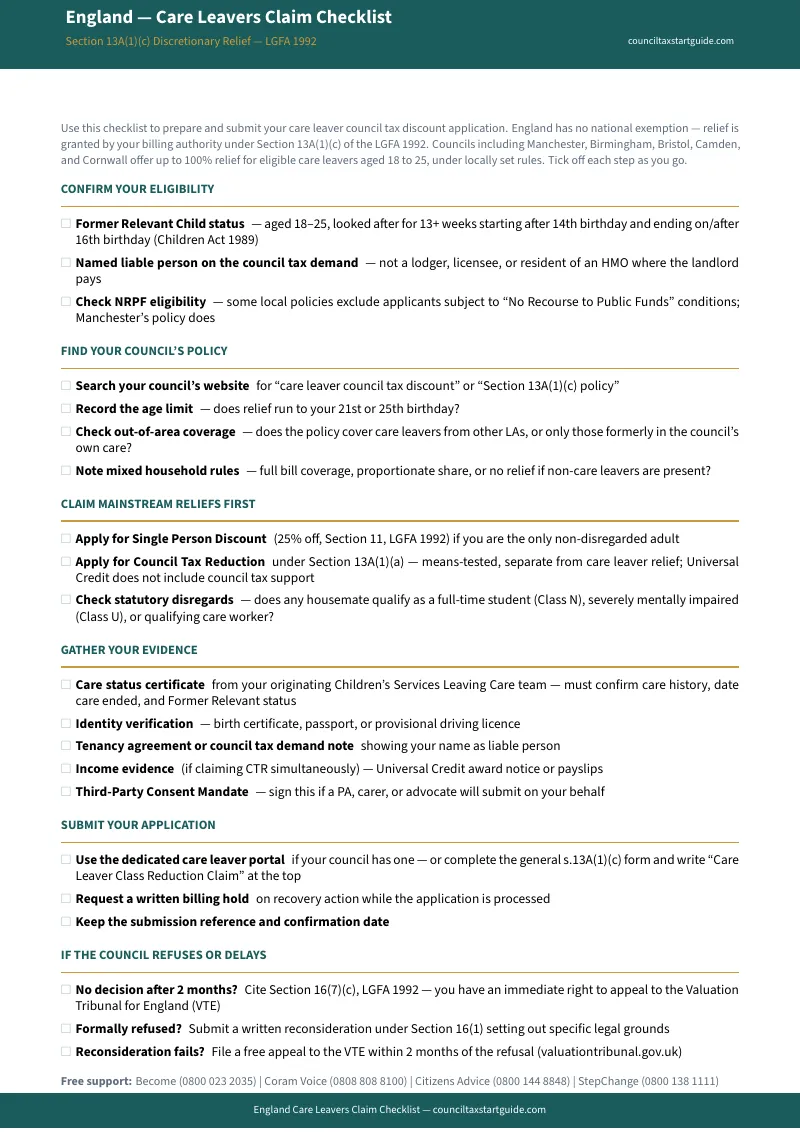
Download the free England Care Leavers Claim Checklist to see whether you qualify and what evidence to gather. When you're ready for the full policy comparison worksheet, the evidence checklist, the backdating template and the challenge framework, get the complete guide for .
Important: if you are behind on council tax payments or facing enforcement action, contact StepChange, National Debtline, or Citizens Advice for free, independent debt advice before buying anything.
Frequently Asked Questions
What if the rules change after I buy?
We update the guide when the rules change. Email us any time, even years later, and we'll send you the current edition free.