
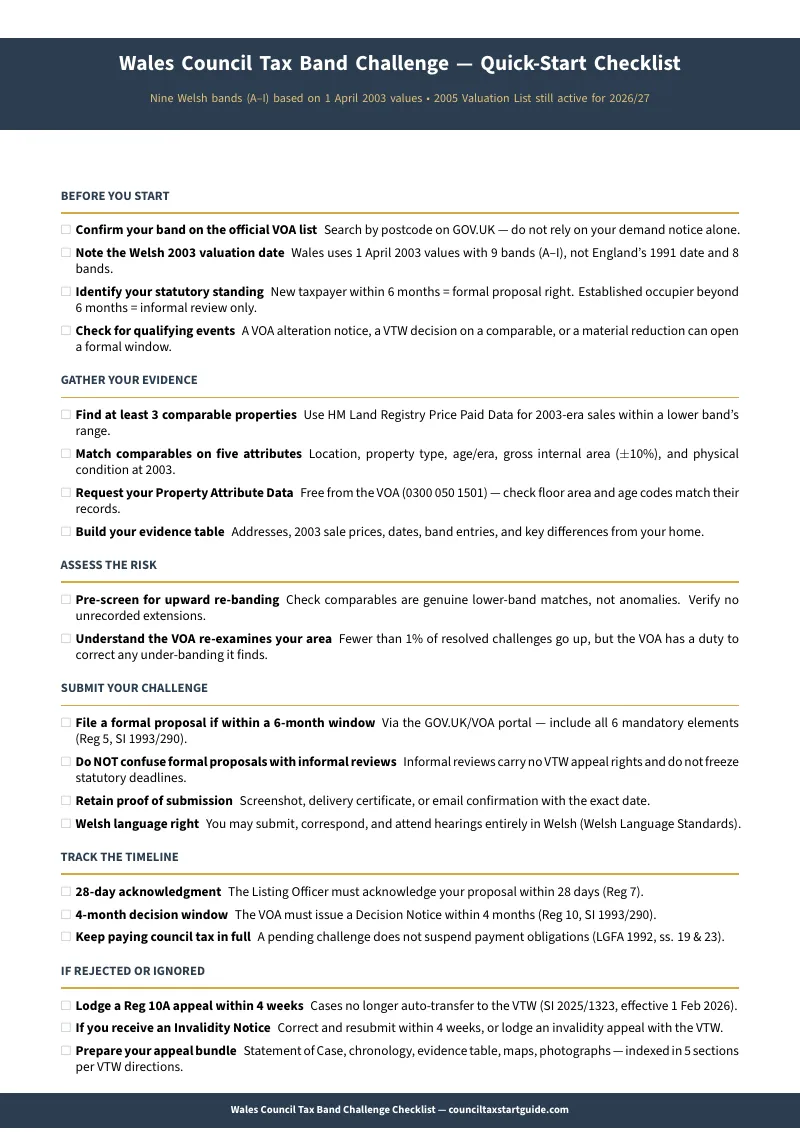
Your Neighbours Pay Less — and Nobody Told You Why
The house next door is the same size, the same type, built the same year. But their council tax band is lower than yours. You've been overpaying since the Welsh valuation list came into force in 2005 — and nobody's job is to check your band for you.
You looked online, saw you can challenge, and then hit the wall. Welsh bands are based on what your property was worth on 1 April 2003 — not what it's worth now, and not the 1991 date that English guides keep quoting. Wales has nine bands instead of eight, different thresholds, a different appeal tribunal, and a set of 2025 procedural reforms that most advice articles haven't caught up with. The free government pages tell you what to do but not how to build the evidence pack that actually gets a band changed.
The Welsh Evidence Assembly System
The Welsh Evidence Assembly System inside this guide is the difference between a challenge that gets a standard rejection and one that gets a proper review. VOA statistics show roughly 35% of resolved Welsh challenges result in a band reduction. The ones that succeed come with structured comparable evidence pegged to 1 April 2003 values and a clear valuation argument. The ones that fail arrive with vague complaints about neighbours' bills or, worse, evidence citing current market prices that the VOA cannot use.
This guide walks you through the entire Welsh process — from checking whether a challenge is worth making, through building a VOA-ready evidence pack, to appealing at the Valuation Tribunal for Wales if the VOA says no. It covers every route: the formal Proposal for new owners within their six-month statutory window, and the informal Band Review for longstanding residents who need strong 2003 comparators to get the VOA's attention.
What's Inside
- Upward Rebanding Risk Pre-Check — before you submit anything, this self-assessment checks whether your property has unrecorded extensions, garage conversions, or structural changes that could trigger a band increase instead of a decrease. Upward revisions affect fewer than 1% of challenges across England and Wales, but the risk concentrates on properties with undeclared alterations. The pre-check flags the scenarios that matter so you make an informed decision
- 2003 Comparable Valuation Matrix — the VOA values Welsh properties at 1 April 2003 prices. Modern Zoopla or Rightmove estimates are irrelevant to a statutory challenge. This matrix helps you log up to five lower-band properties in your area, apply the VOA's four-point criteria (location, property type, construction era, and floor area within ±10%), and source the 2003-era sales data that carries real evidential weight
- Property Attribute Data Walkthrough — PAD shows the square meterage, property type, age code, and structural details the VOA holds for each address. If the VOA's records are wrong about your home — wrong property type, wrong floor area — that is evidence in itself. The walkthrough explains how to request your own PAD and your comparators' through the VOA's free channels
- Statutory Route Selector — determines whether you qualify for a formal Proposal (liable for less than six months, or a VOA band alteration notice in the last six months, or a qualifying material change) or an informal Band Review (longstanding residents). The distinction matters: a Proposal forces a binding VOA decision and opens a direct route to the Valuation Tribunal for Wales, while a Band Review is discretionary and carries no statutory appeal right if the VOA declines
- VOA Proposal Checklist — step-by-step tick list for the online challenge form and the paper submission route. Covers every mandatory field, how to attach evidence, what to write in the reasons section, and what to diary after you submit
- Statutory Deadlines Tracker — the six-month proposal window, the VOA's four-month decision target (under 2025 procedural reforms), the VTW appeal window, and the council's two-month response period for discount and reduction grievances. Every deadline logged in one place so nothing slips
- VTW Evidence Bundle Organiser — if the VOA rejects your Proposal, the Valuation Tribunal for Wales hears the appeal. Under updated regulations, automatic referral from the VOA to the VTW has been abolished — you decide whether to escalate. The organiser indexes your hearing pack and running order against the dates in the tribunal's directions
- Post-Reduction Refund Audit — when a band is reduced, your council must backdate the overpayment to the date the wrong band took effect — potentially back to 2005 when the current Welsh list started. The audit section helps you calculate the expected refund across every year of overpayment and verify the council's figures
- Sibling guide routing — not every council tax problem is a band challenge. If your situation is actually a council tax reduction for low income, a discount or exemption for disability, carers, or single occupancy, or a second-home or empty-home premium, the guide routes you to the right scheme instead of letting you waste time on the wrong process
Who This Guide Is For
- Householders in Wales who have checked their neighbours' bands on the VOA list and found that similar properties are in a lower band
- Recent home buyers within their six-month statutory window who want to use their formal Proposal right before it expires
- Longstanding residents who suspect their band has been wrong since 2005 and want to build a strong case for an informal Band Review
- Anyone whose VOA challenge was rejected and who wants to understand their appeal options at the Valuation Tribunal for Wales
- Adult children or carers helping a relative who is not comfortable navigating the process online
- Householders confused by the upcoming 2028 revaluation who want to know whether a challenge now still makes sense (it does — the revaluation has been deferred)
Why Not Just Use GOV.UK?
The official route through GOV.UK and the VOA is completely free — this guide never pretends otherwise. What the government pages give you is the what: check your band, submit a challenge, appeal if refused. What they don't give you is the how.
GOV.UK doesn't provide a structured matrix to identify valid 2003 comparators using the VOA's own four-point criteria. It doesn't explain how to assess whether your property's alteration history creates a risk of upward rebanding. Most online advice is written for England's eight-band, 1991-baseline system — it uses the wrong valuation date, the wrong band thresholds, and the wrong tribunal. And when the VOA rejects your challenge, the government site won't walk you through the VTW's evidence-exchange process or help you prepare a hearing bundle.
Claims firms will do all of this for you — typically 25–40% plus VAT of any backdated refund. On a £3,000 refund, that could mean £900–£1,440 or more in fees. This guide equips you to follow the same free route yourself and keep every penny of the refund.
Satisfaction Guarantee
Full refund, no time limit. If the guide isn't what you expected, email [email protected] and you'll get your money back. No questions, no deadline.
Start Your Challenge
Download the free checklist to see whether a challenge is worth making, or get the full Welsh Evidence Assembly System — with the Upward Rebanding Risk Pre-Check, 2003 Comparable Valuation Matrix, Statutory Route Selector, VOA Proposal Checklist, VTW Evidence Bundle Organiser, Statutory Deadlines Tracker, and Post-Reduction Refund Audit — for .
Frequently Asked Questions
What if the rules change after I buy?
We update the guide when the rules change. Email us any time, even years later, and we'll send you the current edition free.