Your Parent Has Dementia. The Council Tax Bill Is Wrong. And Nobody at the Council Mentioned It.
Your mum was diagnosed with dementia three years ago. You've been managing her Adult Disability Payment claim, the Social Security Scotland assessments, the GP appointments. Somewhere between the memory clinic referrals and the Power of Attorney paperwork, nobody mentioned that she qualifies for a council tax disregard in Scotland — and that it can be backdated to the day the conditions were first met, with no statutory time limit.
You found your council's website. It says to fill in a form and get the GP to sign a medical certificate. It does not say that your GP practice may try to charge £25 to £50 for a signature, or refuse to sign it altogether. It does not explain that "severe mental impairment" is a statutory tax term under the Local Government Finance Act 1992, not a medical or personal judgement. It does not tell you what happens when the council refuses to backdate more than 12 months, even though there is no statutory limit. And it does not explain how an SMI disregard interacts with a carer disregard, the disability band reduction, a care home exemption, or whether water and sewerage charges disappear along with the council tax.
The Scottish SMI and Disability Claim System is a structured administrative toolkit that walks you through the entire claim from eligibility check to refund — across all 32 Scottish local authorities. It covers the parts that council websites, Citizens Advice Scotland factsheets and charity guides leave out: how to reconstruct backdating dates across multiple tax years, how to challenge a GP who demands a fee or refuses to sign, how to calculate the correct discount for your household composition, how to stack every available relief, and how to appeal when the council says no — through a formal Section 93 grievance and a free appeal to the First-tier Tribunal for Scotland Local Taxation Chamber.
What's Inside the Guide
The Three-Limb Eligibility Test — Mapped to Your Evidence
The SMI disregard requires three things: a medical certificate from a registered medical practitioner confirming permanent impairment of intelligence and social functioning, entitlement to a qualifying benefit under Scottish statutory orders, and a household composition that produces a discount. The guide maps each condition to the exact evidence the council needs — not just "a benefit letter" but which letter, from which agency (Social Security Scotland, DWP, or HMRC), showing which dates. You will know before you contact the council whether you qualify and what to send.
The Complete Qualifying Benefits List for 2026/27
Adult Disability Payment (ADP), Pension Age Disability Payment (PADP), Attendance Allowance (any rate), DLA Care (middle or highest rate), Scottish Adult Disability Living Allowance (SADLA), PIP Daily Living (standard or enhanced), Armed Forces Independence Payment, Constant Attendance Allowance, and Universal Credit only where the award includes the LCWRA element or the person has been assessed as having Limited Capability for Work. The guide explains each benefit, tells you where to find the proof letter, and covers the transition from DWP legacy benefits (PIP, Attendance Allowance) to Social Security Scotland's devolved payments — including what to do when a benefit entitlement start date doesn't align neatly with the council tax billing period.
The GP Medical Certificate — How to Get It Signed Without a Fee
GP practices across Scotland routinely charge between £20 and £50 to complete the council tax medical certificate, or refuse to sign it until a formal memory clinic assessment is finalised. The guide includes a professional cover letter you can give the practice explaining that the certificate confirms a statutory functional test under Paragraph 2 of Schedule 1 to the Local Government Finance Act 1992, not a clinical assessment. The regulations specify any registered medical practitioner — not only the patient's own GP — so if one surgery refuses, you can ask another doctor. The guide covers both the cover letter and the alternative-doctor route.
The Household Composition Calculator
The size of the discount depends entirely on who else lives in the property. A person certified as severely mentally impaired is "disregarded" — they stop counting as an adult for council tax. If they live alone, or only with other disregarded people, the property qualifies for a full Class 23 exemption — 100% off, including water and sewerage charges. If one other countable adult lives there, the household gets a 25% single-person discount. But disregards stack: a live-in carer providing 35 or more hours of care a week (who is not the spouse, partner or a child under 18 of the person they care for) is also disregarded, and a full-time student is disregarded under a separate rule. The guide includes a household flowchart that maps every common Scottish living arrangement to the correct outcome — including the multi-adult households where three or four people live in the property but zero count.
The Disability Band Reduction — Separate Relief That Stacks
If the property has been adapted for a disabled resident — an extra room used mainly because of the disability, an additional bathroom or washroom, or wheelchair access space that a non-disabled person would not need — the household may qualify for the Disabled Band Reduction Scheme. The reduction drops the council tax to the next band down (or gives a one-sixth reduction for Band A properties). This is separate from the SMI disregard and can be claimed alongside it. The guide covers the three qualifying conditions, the evidence the council needs (including what counts as "substantially used"), and how to apply at any Scottish council.
The Backdating Date-Reconstruction Worksheet
There is no statutory time limit on backdating in Scotland. The disregard runs from the date all conditions were first met — the certified onset of the impairment, the qualifying benefit entitlement and residence in the property — even if that was years ago. Local authorities sometimes try to limit refunds to the current financial year or 12 months, but when you present a GP certificate confirming a historical onset date alongside proof of a qualifying benefit on that same date, councils have the discretionary authority to issue retroactive refunds across multiple years. Families routinely recover between £1,000 and £5,000 in overpaid council tax. The worksheet walks you through aligning the diagnosis date, the benefit award date and the council tax billing history year by year, so you can calculate the refund the council owes and submit a backdating request with the dates already documented.
Care Homes, Hospital Stays, and Empty Properties
When a relative moves permanently into a care home or hospital, their former home can qualify for a Class 5 exemption — council tax drops to zero for as long as they remain in residential care. But if the exemption is not claimed and the property stays empty for more than 12 months, the council can apply a long-term empty home premium of up to 100% on top of the standard bill. The guide covers Class 5 applications, the evidence the council needs, and how to avoid the empty home premium trap entirely.
When the Council Says No — Section 93 Grievances and Local Taxation Chamber Appeals
Councils sometimes refuse claims or refuse to backdate. The guide covers both routes. First, a formal written grievance notice to the local authority under Section 93 of the Local Government Finance Act 1992. The council has two months to respond. If the grievance is rejected or ignored, you have four months from the original grievance date to lodge a free appeal with the First-tier Tribunal for Scotland Local Taxation Chamber (established April 2023). The guide includes a grievance letter template, a statutory deadline tracker and a tribunal evidence-preparation checklist so you can prepare the appeal yourself — without paying a solicitor.
Water and Sewerage Charges — What Actually Gets Reduced
Scottish Water charges are billed through your council tax notice. A full Class 23 SMI exemption eliminates both council tax and water and sewerage charges. A 25% single-person discount following an SMI disregard reduces only the council tax — water charges are treated separately under specific statutory reduction rules. The guide explains the interaction for every discount scenario so there are no surprises on the next bill.
Who This Guide Is For
- Adult children managing a parent's council tax in Scotland after a dementia, Alzheimer's or stroke diagnosis — especially when backdating could mean a refund of over a thousand pounds
- Spouses and partners living with someone who has a severe mental impairment, who need to understand exactly what discount the household qualifies for and why the carer disregard does not apply to them
- Non-spousal carers living in the same property as the person they care for, who may qualify for a carer disregard on top of the SMI disregard — potentially reducing the household to zero countable adults
- Families with a wheelchair user or a disabled person in an adapted home, who may qualify for the disability band reduction separately from or alongside an SMI disregard
- Relatives arranging a move into a care home or hospital who need to protect the empty property from surcharges while claiming the correct exemption
- Anyone in Scotland whose council has refused an SMI claim or refused to backdate, and who needs to challenge the decision through a formal grievance or tribunal appeal
Why Not Just Use the Free Resources?
Citizens Advice Scotland, Age Scotland, Alzheimer Scotland and mygov.scot all publish useful introductory guidance on council tax relief in Scotland. None of them give you the operational tools to handle the parts of the claim that actually go wrong.
- mygov.scot and council websites provide eligibility summaries and application links. They signpost you to your local council but do not supply a backdating date-reconstruction worksheet, a household composition calculator, or any guidance on what to do when the council refuses to backdate. Each of Scotland's 32 councils handles the process differently — some have online portals, some use paper forms, and processing backlogs vary from days to months.
- Age Scotland's M18 guide covers council tax and disability in detail. It is accurate and well-written, but it is a reading guide — not a case-management toolkit. It does not include fillable worksheets, GP cover letters, evidence assembly logs, or appeal templates.
- Citizens Advice Scotland's checkmycounciltax.scot tool screens for eligibility. It tells you what you might qualify for. It does not help you assemble the evidence, reconstruct the backdating timeline, handle a reluctant GP, or prepare a grievance when the council rejects your claim. Local bureau appointments for specialist welfare rights advice can take weeks.
- UK-wide charities (Dementia UK, Age UK, Scope) cover England and Wales in detail but often miss Scottish-specific rules. They reference the Valuation Office Agency, Valuation Tribunal England and DWP benefits without covering the Scottish Assessors, the Local Taxation Chamber, or devolved benefits like ADP and PADP.
- Commercial claims firms handle the process for you — and take 25% to 35% plus VAT of the refund. On a multi-year backdated refund of £3,000, that is £750 to £1,050 plus VAT. The claim process through your council is free. The guide shows you how to do it yourself.
Free resources explain that the discount exists. This guide gives you the tools to claim it, backdate it, and challenge a refusal — without paying a claims company a share of your refund.
— A Fraction of One Year's Discount
The average Band D council tax in Scotland is around £1,450 a year. A 25% single-person discount following an SMI disregard saves over £360 annually. A full Class 23 exemption saves the entire bill — including water and sewerage charges. Families who backdate across multiple years routinely recover between £1,000 and £5,000. Claims management firms take 25% to 35% plus VAT of anything they recover. This guide costs less than a single hour of a welfare rights consultant's time, and you keep every penny of the refund.
Your download includes 11 PDFs, instant download:
- Council Tax Exemptions for Severe Mental Impairment and Disability in Scotland (50 pages) — the three-limb eligibility test, all qualifying benefits for 2026/27 including the ADP and PADP transition, GP medical certificate rules, household composition calculator, disability band reduction, carer disregards, care home and hospital exemptions, backdating rules, step-by-step claim process across all 32 councils, Section 93 grievance guidance, Local Taxation Chamber appeal guidance, and water and sewerage charge interactions
- Evidence Assembly Log — track every document from collection to submission
- Backdating Date-Reconstruction Worksheet — align the three statutory dates year by year and calculate the refund
- GP Appointment Preparation Sheet — what to bring, what to ask, and what to say if the surgery charges a fee
- GP Cover Letter — professional statutory letter explaining the LGFA 1992 definition to the doctor
- Household Composition Worksheet — map every resident to a disregard category and determine the correct discount
- Section 93 Grievance Letter Builder — structured template for the formal written grievance notice
- LTC Appeal Evidence Checklist — preparation checklist for a Local Taxation Chamber hearing
- Statutory Deadline Tracker — track every grievance and appeal window so you never miss a filing date
- Agency Communication Log — record every phone call, email and letter with the council, GP surgery and benefit agencies
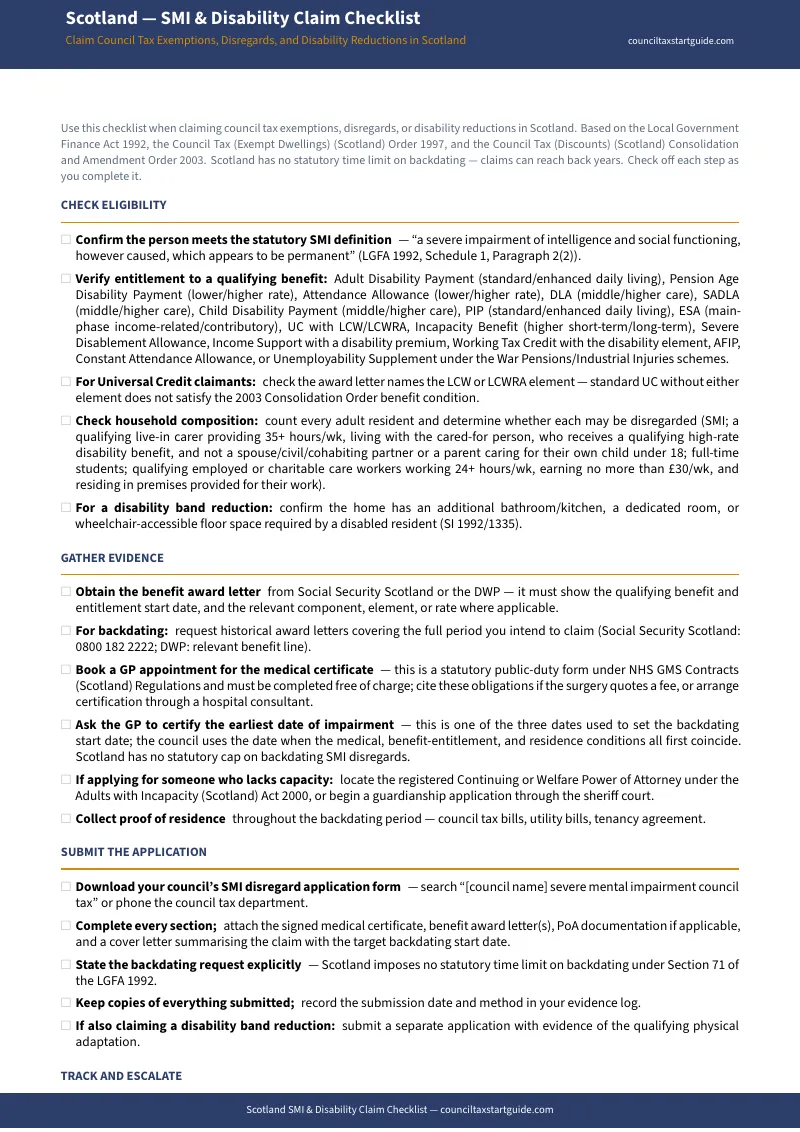
- Scotland SMI and Disability Claim Checklist (free) — 21-item checklist covering every condition, document and step in the claim process
Instant PDF download. Start your claim tonight.
Full refund, no time limit. If this guide does not help you navigate the claim, email [email protected] for a full refund. No questions asked.
Not ready for the full guide? Download the free Scotland SMI and Disability Claim Checklist — a 21-item checklist of the conditions, evidence and claim steps. It tells you what to gather and in what order. The full guide tells you what to do when the GP charges, the council refuses, or the backdating gets complicated.
The council owes you a discount. Possibly years of it. This guide shows you how to claim every penny.
Frequently Asked Questions
What if the rules change after I buy?
We update the guide when the rules change. Email us any time, even years later, and we'll send you the current edition free.