You Qualify for a Council Tax Discount. Your Council Hasn't Told You.
Your partner moved out six months ago. You've been paying the full council tax bill because nobody told you that a single-adult household gets an automatic 25% reduction. Or your adult child is away at university — technically disregarded under the law — but the council's system still counts them. Or you got one of those review letters from a company you've never heard of, threatening to cancel the discount you've held for years, because a credit check found a second name at your address.
You searched online. GOV.UK told you to "contact your council." Your council's website gave you an application form and a list of who qualifies. It did not tell you how to prove sole residence when your ex is still on the credit file, how to calculate a backdated refund across three financial years, how to respond to an automated audit without accidentally triggering a cancellation, or what to do when the council says you were never entitled in the first place.
The Household Eligibility and Disregard Audit System is a structured process-navigation toolkit that walks you through every stage — from working out whether your household qualifies, through the evidence you need and the claim process, to surviving a council review and appealing a refusal. It covers the parts that council websites, Citizens Advice factsheets, and MoneySavingExpert guides leave out: the disregard categories that turn multi-adult homes into single-person-discount households, the backdating rules that have no statutory time limit, the review-response strategy that keeps your discount intact, and the Section 16 appeal route when your council gets it wrong.
What's Inside the Guide
The Household Disregard Audit — Who Counts and Who Doesn't
The 25% discount is not just for people living alone. Under Schedule 1 of the LGFA 1992, twelve categories of adult are "disregarded" — invisible for council tax purposes. Full-time students, apprentices earning under the weekly cap, people with severe mental impairment, live-in carers, school leavers aged 18–19, hospital patients, care home residents, people detained under the Mental Health Act, members of visiting forces, and others. If only one non-disregarded adult remains, the household qualifies. The kit includes the Household Resident and Disregard Audit Worksheet that walks you through every resident, checks each one against the statutory disregard list, and tells you the exact discount or exemption your home is entitled to.
The "Sole or Main Residence" Evidence Framework
When a partner moves out, the council does not always take your word for it. The legal test for who "lives" at a property comes from case law — Lone v Hounslow and Stark v Hounslow — which looks at security of tenure, financial ties, family base, and intention to return. The guide maps each factor to the evidence that councils and tribunals actually accept: new tenancy agreements, electoral roll changes, DVLA address updates, bank statement address history, and utility bill transfers. Partners who work away, are posted overseas, or serve in the armed forces present their own problems — the guide covers every common arrangement.
The Retrospective Claim Calculator
There is no statutory time limit on backdating the Single Person Discount in England. Council tax liability is calculated on a daily basis under Section 2 of the LGFA 1992, and the discount applies from the day your household first became eligible. The calculator aligns the key dates — when the second adult left, when a disregard condition was first met, when the benefit was awarded — across multiple tax years, calculates the overpayment for each year, and structures a formal refund request. On a Band D property averaging over £2,100 a year, three years of unclaimed discount is worth more than £1,600.
The SPD Audit Review Response Planner
Councils contract third-party audit firms — principally NEC Software Solutions and Civica — to run automated cross-checks against credit reference agency data. If a second name appears at your address, a review letter arrives, typically giving you 14 to 21 days to prove you still qualify. A second name on the credit file does not mean a second adult lives there — it might be an ex-partner's old account, an adult child registered for credit at their parents' address, or a lodger who left years ago. The planner walks you through exactly what to send, what not to send, and how to avoid the most common mistake: providing information that triggers a backdated cancellation instead of confirming your discount.
The Section 16 Grievance and Appeal Tracker — When Your Council Says No
If the council refuses your claim or cancels your discount, you have a formal statutory route. Under Section 16(4) of the LGFA 1992, you serve a written grievance on the billing authority. The council has two months to respond. If it rejects the grievance or fails to respond, you appeal to the Valuation Tribunal for England — free, independent, and binding on the council. The tracker covers the grievance letter, the two-month deadline, the VTE appeal form, the evidence bundle, and what to expect at the hearing. It also warns you about the enforcement trap: under Regulation 57, discount disputes cannot be raised in Magistrates' Court liability order proceedings — a mistake that costs taxpayers their appeals every year.
Notification Duties — What You Must Report and When
When your circumstances change — an adult moves in, a student graduates, an apprentice gets a pay rise — you have 21 days to notify the council in writing if the discount no longer applies or is too large. Failure without reasonable excuse risks a £70 civil penalty under Schedule 3 of the LGFA 1992, rising to £280 if you ignore a secondary request. The guide maps every trigger event to the reporting requirement and the evidence the council needs.
How the SPD Stacks with Other Reductions
The Single Person Discount is not the only relief available to a qualifying household. Council Tax Reduction (the means-tested scheme for low-income households), the Disabled Band Reduction Scheme, and the Carer Disregard can all interact — and they are applied in a specific statutory order. The guide explains the calculation sequence so you can check your bill is correct, and cross-references our companion guides for households that need more than the SPD alone.
Who This Guide Is For
- Single adults who have not yet claimed the 25% discount — whether you live entirely alone or with disregarded residents such as students, apprentices, or a person with severe mental impairment
- Separated or divorcing residents who need to prove sole occupancy when a former partner's name is still on the credit file, electoral roll, or council records
- Parents whose adult child is at university, on an apprenticeship, or a school leaver aged 18–19 — and who may have lost their discount when the child turned 18
- Pensioners living alone after a bereavement or a spouse's move into residential care, especially where backdating could mean a refund covering several years
- Adult children or carers managing council tax on behalf of an elderly or vulnerable relative
- Anyone who has received an SPD review letter from NEC, Civica, or their council and is not sure how to respond without losing the discount
- Anyone whose council has refused a claim or cancelled a discount and who needs to challenge the decision through the formal grievance and appeal route
Why Not Just Use the Free Resources?
GOV.UK, Citizens Advice, Age UK, and MoneySavingExpert all publish useful introductory guidance on the Single Person Discount. None of them give you the structured tools to handle the parts of the claim that actually go wrong.
- Council websites provide the application form and a list of who qualifies. They do not provide a Household Resident and Disregard Audit Worksheet, a Retrospective Claim Calculator, an SPD Audit Review Response Planner, or any guidance on what to do when the council refuses to backdate. Many councils actively resist large backdated claims.
- Citizens Advice provides detailed knowledge bases on eligibility and entitlement. Local bureau appointments for specialist welfare rights casework can take 12 to 14 weeks. The guide gives you a structured workflow to act now — claim tonight — instead of waiting for a callback.
- MoneySavingExpert publishes a comprehensive editorial article on council tax discounts. It covers the basics well but does not include downloadable worksheets, a review-response planner, a backdating calculator, or an appeal tracker.
- Commercial claims companies handle band challenges and overpayment recovery for you — and take 30% to 40% plus VAT of the refund. On a three-year backdated refund of £1,600, that is £480 to £640 plus VAT. The claim process through your council is free. The guide shows you how to do it yourself.
Free resources explain that the discount exists. This guide gives you the tools to claim it, backdate it, survive a review, and appeal a refusal — without paying a claims company a share of your refund.
— A Fraction of One Year's Discount
A Band D council tax bill in England averages over £2,100. A 25% discount saves more than £500 a year. A three-year backdated claim is worth more than £1,600. Claims management companies take 30% to 40% plus VAT. This guide costs less than a single hour of a welfare rights consultant's time, and you can use it for every year the discount applies.
Your download includes 8 PDFs, instant download:
- Council Tax Single Person Discount in England: Eligibility, Disregards and Claims (48 pages) — every statutory disregard category for 2026/27, the sole or main residence test, the claims process, notification duties, calculation order with other reductions, separation and bereavement scenarios, and key resources
- Household Resident and Disregard Audit Worksheet — list every adult, apply the twelve Schedule 1 categories, and look up 25%, 50%, or a full exemption
- Retrospective Claim Calculator — align the eligibility start date and calculate the overpayment for each tax year
- Evidence Assembly Checklist — documents by claim type, including partner-departed sole or main residence evidence
- SPD Audit Review Response Planner — log the letter, explain every flagged name, and list what you will send
- Section 16 Grievance and Appeal Tracker — grievance-to-VTE deadlines, grounds, and hearing notes
- Agency Communication Log — one row per call, email, letter, or portal event, with proof of delivery
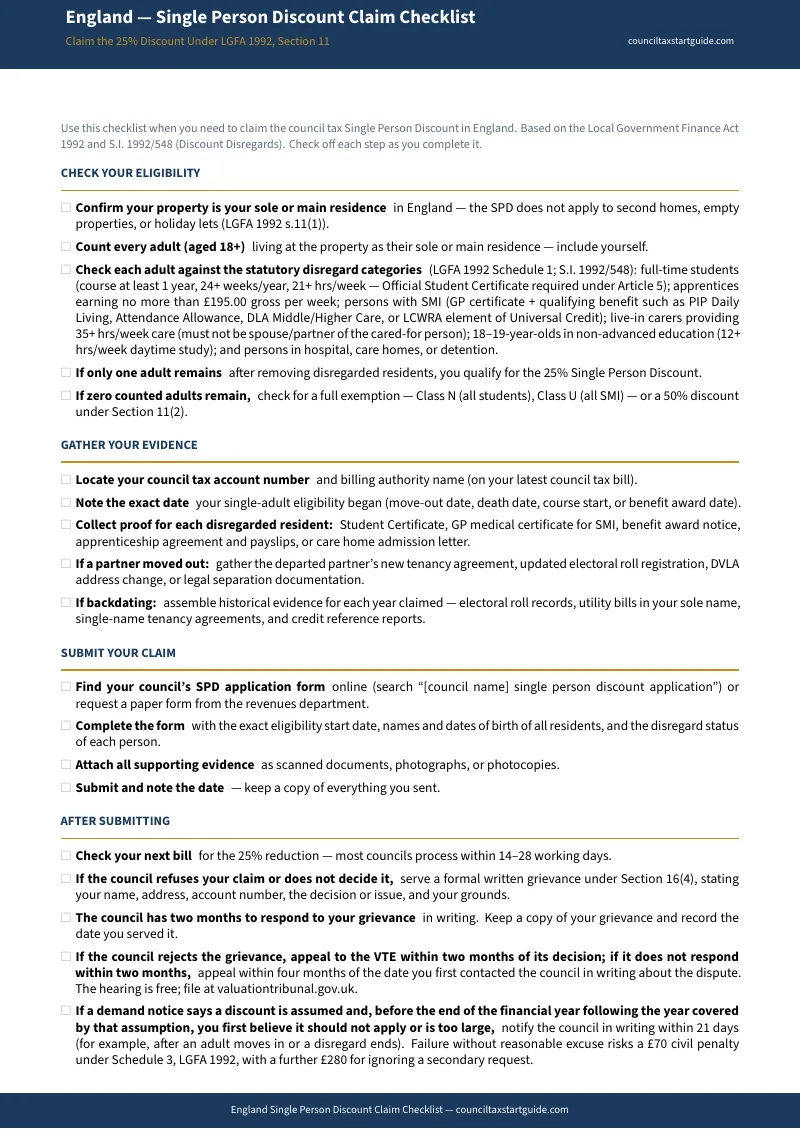
- England Single Person Discount Claim Checklist (free, 2 pages, 20 items) — eligibility, evidence, the claim process, and what to do if your council refuses
Instant PDF download. Start your claim tonight.
Full refund, no time limit. If this guide does not help you navigate the claim, email [email protected] for a full refund. No questions asked.
Not ready for the full guide? Download the free England Single Person Discount Claim Checklist — a 20-item, 2-page checklist of who qualifies, the evidence to gather, and the claim steps. It tells you what to do and in what order. The full kit tells you what to do when the council refuses, the review letter arrives, or the backdating gets complicated.
The council owes you a discount. Possibly years of it. This guide shows you how to claim every penny.
Frequently Asked Questions
What if the rules change after I buy?
We update the guide when the rules change. Email us any time, even years later, and we'll send you the current edition free.