Your Parent Has Dementia. The Council Tax Bill Is Wrong. And Nobody Told You.
Your mum was diagnosed with dementia two years ago. You've been managing her Attendance Allowance claim, the care assessments, the GP appointments. Somewhere between the hospital visits and the benefits paperwork, nobody mentioned that she qualifies for a council tax discount — and that it can be backdated to the day the conditions were first met.
You found the council's website. It says to fill in a form and get the GP to sign a medical certificate. It does not mention that the GP practice may try to charge you £50 for a signature that is legally free. It does not explain that "severe mental impairment" is a statutory tax term, not a diagnosis. It does not tell you what happens when the council refuses to backdate more than six months, even though there is no statutory time limit. And it definitely does not explain how a household with two adults, one of whom qualifies, gets a different discount from a household where the qualifying person lives alone.
The SMI Claim and Backdating System is a structured administrative toolkit that walks you through the entire claim from eligibility check to refund, including the parts that council websites, Citizens Advice factsheets and MoneySavingExpert articles leave out: how to reconstruct backdating dates across multiple tax years, how to challenge a GP who demands a fee or refuses to sign, how to calculate the correct discount for your household composition, and how to appeal when the council says no.
What's Inside the Guide
The Three-Part Eligibility Test — Mapped to Your Evidence
The SMI discount requires three things: a medical certificate from a GP confirming permanent impairment, entitlement to a qualifying benefit, and a household composition that produces a discount. The guide maps each condition to the exact evidence the council needs — not just "a benefit letter" but which letter, from which department, showing which dates. You will know before you contact the council whether you qualify and what to send.
The Complete Qualifying Benefits List for 2026/27
Attendance Allowance (any rate), PIP Daily Living (standard or enhanced), DLA Care (middle or highest), Universal Credit with the LCWRA element, ESA with the support component, Severe Disablement Allowance, Incapacity Benefit, Armed Forces Independence Payment and Constant Attendance Allowance. The guide explains each one, tells you where to find the proof letter, and covers what to do when a benefit has been awarded retrospectively.
The GP Certificate — Free by Law, and How to Enforce It
Under Regulation 22 and Schedule 9 of the NHS (General Medical Services Contracts) Regulations 2015, the SMI medical certificate is a mandatory NHS service. GPs must complete it free of charge. Some practices either don't know this or charge a private medical report fee of £30 to £85 anyway. The guide gives you the exact legal citation and a clear approach to resolving a fee demand or a reluctant GP in a single conversation — no complaint necessary.
The Household Composition Calculator
The size of the discount depends entirely on who else lives in the property. A person certified as severely mentally impaired is "disregarded" — they stop counting as an adult for council tax purposes. If they live alone, the property qualifies for a full exemption. If one other adult lives there, it drops to one countable person and the household gets a 25% discount. If two or more other adults remain, there is no discount from the SMI disregard alone — but other reliefs (Carer Disregard, Disabled Band Reduction) may stack. The guide includes a household flowchart that maps every common living arrangement to the correct outcome.
The Backdating Date-Reconstruction Worksheet
There is no statutory time limit on backdating in England. The discount runs from the date both conditions were first met — the medical impairment and the qualifying benefit — even if that was years ago. The worksheet walks you through aligning the diagnosis date, the benefit award date, and the council tax payment history across multiple years, so you can calculate the refund the council owes and submit a backdating request with the dates already documented.
The Claim Submission Process — Step by Step
How to request the council's application form, what to attach, how to submit it with proof of delivery, and what the council's response timeline looks like. Covers both online portals and paper-based councils. Includes a correspondence tracker so you have a dated record of every interaction.
When the Council Says No — Internal Review and Valuation Tribunal Appeals
Councils sometimes refuse claims or refuse to backdate. The guide covers the internal review request (with template language drawn from the statutory framework), the formal appeal to the Valuation Tribunal for England (free to file), the two-month appeal deadline, what evidence to submit, and what to expect at the hearing.
Post-Death Claims
If a relative qualified for the discount while alive but never claimed, the estate or a family member can submit a retrospective claim. The guide covers the evidence councils accept for post-death claims, how the refund is paid, and the interaction with empty-property exemptions after the person has left the home.
Six Standalone Fillable Worksheets
Eligibility self-assessment, backdating date-reconstruction log, GP certificate preparation sheet, household composition worksheet, claim correspondence tracker, and appeal preparation checklist — each a separate printable PDF you can fill in with a pen, take to the GP surgery or council office, and keep on file.
Who This Guide Is For
- Adult children managing a parent's council tax after a dementia, Alzheimer's or stroke diagnosis — especially when backdating could mean a refund of hundreds or thousands of pounds
- Spouses and partners living with someone who has a severe mental impairment, who need to understand exactly what discount the household qualifies for and why Carer Disregard does not apply to them
- Non-spousal carers living in the same property as the person they care for, who may qualify for an additional Carer Disregard on top of the SMI disregard
- Families whose relative has moved into a care home and who want to audit the council tax paid while the person was still at home
- Anyone whose council has refused an SMI claim or refused to backdate, and who needs to challenge the decision
- Executors or family members dealing with council tax after a death, when the deceased qualified but never claimed
Why Not Just Use the Free Resources?
Citizens Advice, the Alzheimer's Society, Age UK and MoneySavingExpert all publish useful introductory guidance on the SMI discount. None of them give you the operational tools to handle the parts of the claim that actually go wrong.
- Council websites provide the application form and a list of qualifying benefits. They do not provide a backdating date-reconstruction worksheet, a household composition calculator, or any guidance on what to do when the council refuses to backdate. Many councils actively resist large backdated claims.
- MoneySavingExpert ran a high-profile campaign that raised awareness of SMI overpayments. Their editorial guide is excellent for understanding the basics, but it does not include downloadable tools, evidence-reconstruction logs, or appeal frameworks.
- The Alzheimer's Society's Factsheet 414LP covers council tax and dementia. It focuses on dementia specifically and provides limited detail for non-dementia conditions (stroke, Parkinson's, brain injury, learning disabilities). It does not cover GP fee disputes, household composition calculations for multi-adult households, or Valuation Tribunal appeals.
- Citizens Advice provides eligibility checklists. Local bureau appointments for specialist welfare rights advice can take 12 to 14 weeks. The guide gives you the structured workflow to act now, not in three months.
- Commercial claims management companies handle the process for you — and take 25% to 35% plus VAT of the refund. On a multi-year backdated refund of £3,000, that is £750 to £1,050 plus VAT. The claim process is free through the council. The guide shows you how to do it yourself.
Free resources explain that the discount exists. This guide gives you the tools to claim it, backdate it, and challenge a refusal — without paying a claims company a share of your refund.
— A Fraction of One Year's Discount
A Band D council tax bill in England averages over £2,100. A 25% single-person discount on that bill saves more than £500 a year. A full exemption saves the entire amount. Claims management companies take 25% to 35% plus VAT of any backdated refund they recover. This guide costs less than a single hour of a welfare rights consultant's time, and you can use it for every year the discount applies.
Your download includes 8 PDFs, instant download:
- Severe Mental Impairment Council Tax Exemption in England: Claiming and Backdating Guide (49 pages) — the three-part eligibility test, all qualifying benefits for 2026/27, GP certificate rules with NHS regulation citations, household composition calculator, backdating date-reconstruction worksheet, step-by-step claim process, internal review and Valuation Tribunal appeal guidance, post-death claims, and printable worksheets
- Eligibility Self-Assessment Worksheet — fillable two-pillar eligibility test with evidence inventory
- Backdating Date-Reconstruction Log — align the three critical dates and calculate the refund for each financial year
- Claim Correspondence Tracker — log every interaction with the council, GP and DWP with statutory deadline tracking
- GP Certificate Preparation Sheet — documents to bring, what to ask the doctor, and the fee defence script
- Household Composition Worksheet — count disregarded adults and look up the correct relief (25%, 50% or full exemption)
- Appeal Preparation Checklist — Section 16 grievance and Valuation Tribunal evidence bundle checklist
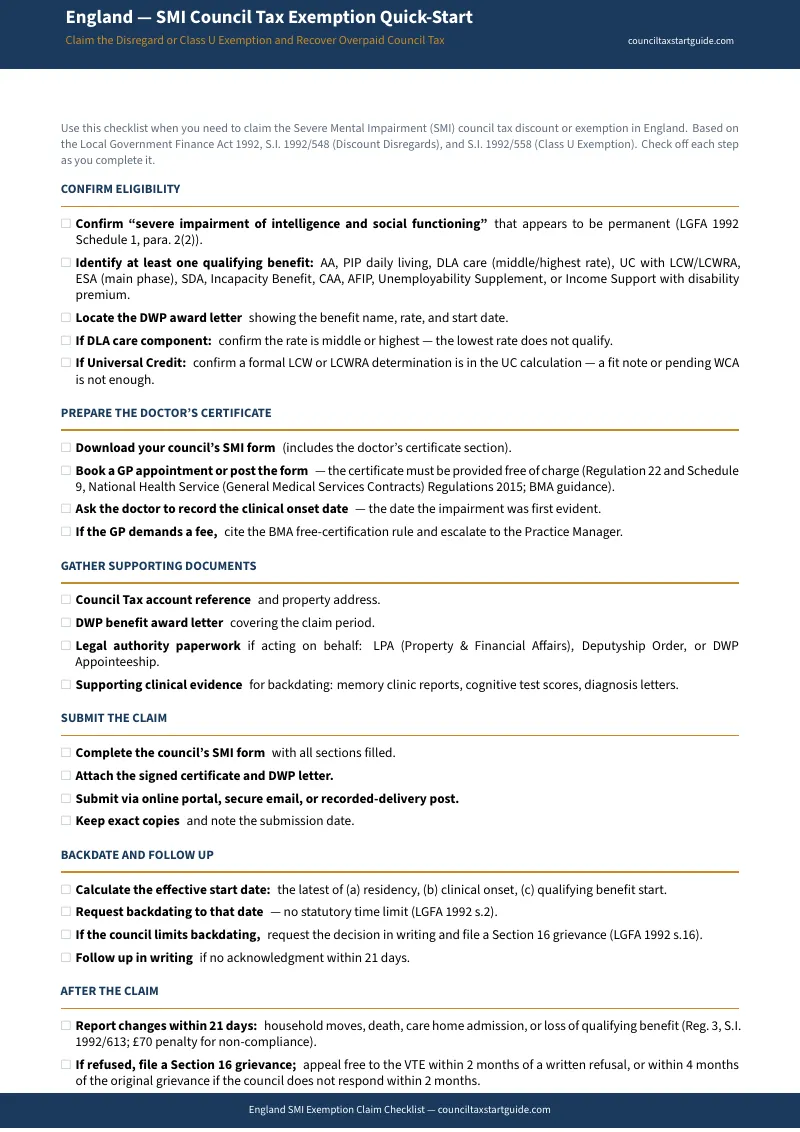
- England SMI Exemption Claim Checklist (free) — 24-item checklist covering every condition, document and step in the claim process
Instant PDF download. Start your claim tonight.
Full refund, no time limit. If this guide does not help you navigate the claim, email [email protected] for a full refund. No questions asked.
Not ready for the full guide? Download the free England SMI Exemption Claim Checklist — a 24-item checklist of the conditions, evidence and claim steps. It tells you what to gather and in what order. The full guide tells you what to do when the GP charges, the council refuses, or the backdating gets complicated.
The council owes you a discount. Possibly years of it. This guide shows you how to claim every penny.
Frequently Asked Questions
What if the rules change after I buy?
We update the guide when the rules change. Email us any time, even years later, and we'll send you the current edition free.