Your council tax bill doesn't have to be this high
You've seen the income band tables on Dorset Council's website. You know there's a scheme that could knock 20%, 40%, 60%, 80% — even 100% — off your bill. But the council's pages leave you stranded: how do you convert your monthly wage slips and Universal Credit statement into the net weekly figure Dorset actually uses? Which benefits get ignored? What happens if your income sits right on a band boundary?
Most people either give up and pay the full amount, or they submit an incomplete application that gets stuck in the system for weeks.
The Dorset Income Band Navigator
This guide is built around one thing: getting you from "I might qualify" to a fully documented, correctly calculated claim — without spending hours on council phone lines or waiting weeks for a Citizens Advice appointment.
It covers the entire Dorset Council working-age scheme for 2026/27, including the income-banded grid introduced on 1 April 2024. Every calculation is walked through step by step, with the specific disregards and exclusions that apply in Dorset — not generic national advice that mixes up rules from different councils.
What's Inside
- Income band calculation worksheets — convert monthly wages, zero-hours payslips, self-employed accounts or Universal Credit statements into Dorset's net weekly income figure, with the £20 earned income disregard and all excluded benefits (PIP, DLA, Carer's Allowance, UC housing/carer/disabled child/LCWRA elements) applied in the right order
- The full 2026/27 income band grid — thresholds for every household type (single, couple, family with 1/2/3+ children), so you know your exact discount percentage before you submit anything
- Evidence assembly checklist — the specific documents Dorset Council's benefits team expects for identity, National Insurance, income, capital and housing, organised by employment type (PAYE, self-employed, UC, out of work)
- Universal Credit trap-avoidance guide — the step-by-step process to claim Council Tax Reduction at the same time as your UC claim, so you don't end up with months of full bills because nobody told you the two systems don't talk to each other
- Backdating request framework — how to draft the written "good cause" request for up to 3 months of backdated support, with the evidence Dorset Council has accepted in practice and the deadlines that apply
- Section 13A hardship application guide — if your income is too high for the standard scheme but you're still struggling, the guide walks through Dorset Council's discretionary hardship fund and how to make the case
- Decision audit walkthrough — how to read a decision notice, check whether the council correctly applied disregards and non-dependant deductions, and file a formal review or Valuation Tribunal appeal if the numbers don't add up
- Change-of-circumstances reference — which changes you must report within 21 days, which ones don't affect your award, and what happens if you report late
Who This Is For
- Working-age Dorset Council residents on a low income or fluctuating earnings
- Universal Credit claimants who haven't yet made a separate council tax claim
- People with disabilities, carers, and single parents navigating disregards and exemptions
- Family members or friends helping someone who struggles with online forms and evidence gathering
- Anyone whose CTR application was refused, reduced or recalculated and who wants to check the decision
This guide covers the Dorset Council area only — Weymouth, Portland, Dorchester, Sherborne, Purbeck and the rural districts. If you live in Bournemouth, Christchurch or Poole, you're under BCP Council, which runs a different scheme.
Why Not Just Use the Council Website?
Dorset Council's pages give you the rules. They don't give you a system for working through them. The online portal asks for your net weekly income — but doesn't explain how to calculate it after applying the earned income disregard and stripping out excluded benefits. The backdating page says you need "good cause" — but doesn't give you a template or tell you what Dorset has actually accepted. The hardship fund page says the council can use its discretion — without explaining what a strong application looks like.
The council's job is to process claims efficiently. This guide's job is to help you submit one that's right the first time.
What This Guide Is Not
This is an independent self-help tool — not legal advice, not debt advice, and not connected to Dorset Council, the DWP or any government body. Official application routes through Dorset Council are completely free. If you're in arrears or facing enforcement action, your first call should be to free debt advice: StepChange (0800 138 1111), National Debtline (0808 808 4000) or Citizens Advice (0800 144 8848).
Satisfaction Guarantee
Full refund, no time limit. If the guide doesn't help, email [email protected] and we'll refund you — no questions, no forms, no waiting period.
Get Started
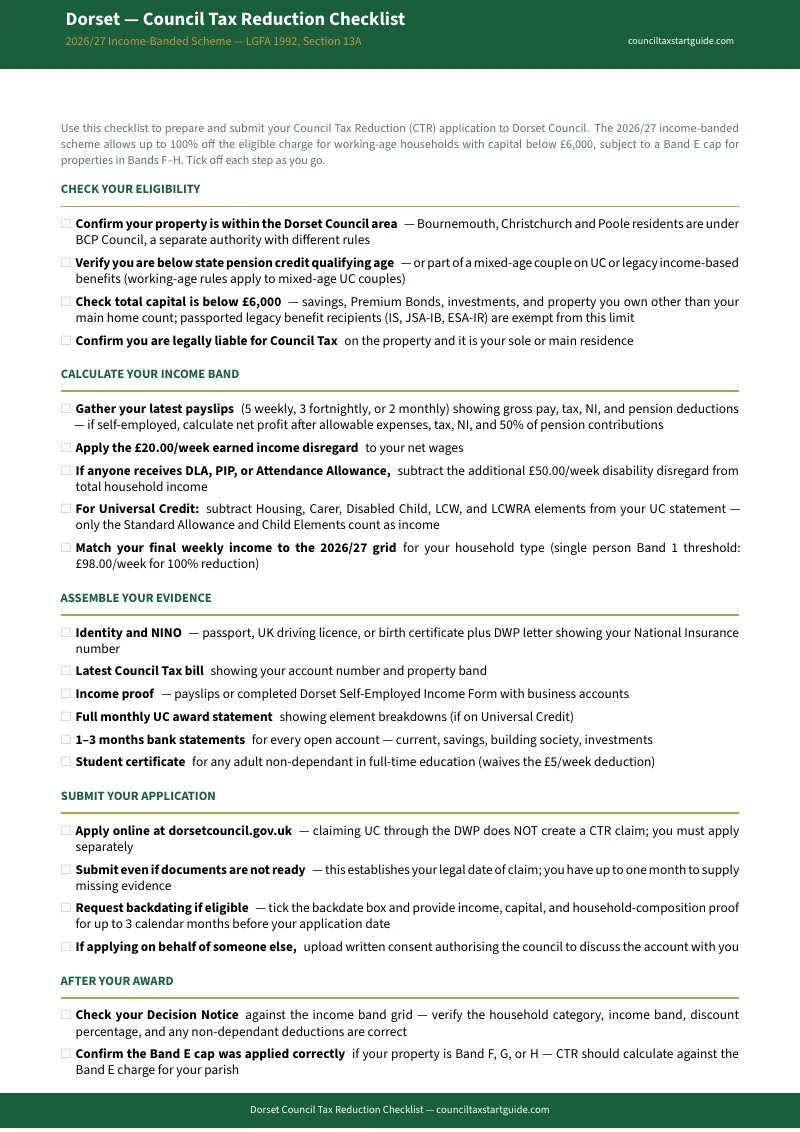
Download the free checklist to see the basic steps and evidence list. When you're ready for the full calculation worksheets, backdating templates and decision audit framework, the complete guide is — a one-time purchase with lifetime access to updates.
Frequently Asked Questions
What if the rules change after I buy?
We update the guide when the rules change. Email us any time, even years later, and we'll send you the current edition free.