Your Annexe Has Its Own Council Tax Band. The Council Hasn't Told You How to Pay Nothing.
The letter arrived without warning: a separate council tax bill for the annexe your parents built for your mum five years ago. Band A, full charge. You rang the council. They said "that's correct, it's a separate dwelling." You rang the Valuation Office Agency. They said "we only deal with banding — contact your council about discounts." Neither told you that a 72-year-old parent in a family annexe triggers a 100% statutory exemption that reduces the bill to zero. Neither mentioned the 50% family discount, the planning-restriction exemption for empty annexes, or the fact that backdating has no statutory time limit.
The information exists across the Local Government Finance Act 1992 and half a dozen statutory instruments — scattered between the VOA, your billing authority, GOV.UK, and community forums where homeowners swap contradictory advice. Council websites list the reliefs in a table but do not explain which body you apply to, how to assemble the evidence pack that actually gets a claim approved, or what to do when the council refuses. MoneySavingExpert covers the basics. Citizens Advice covers the basics. Neither of them gives you the structured decision path, the evidence checklists, or the challenge route when your council says no.
The Annexe Liability Decision System is a structured process-navigation toolkit that walks you through every stage — from determining whether your annexe should have its own band at all, through identifying the exact relief route (Class W exemption, Class T exemption, 50% Family Annexe Reduction, or discount stacking), to assembling the evidence, submitting the claim, and challenging a refusal through the Section 16 grievance process and the Valuation Tribunal for England. It separates what the VOA decides from what the council decides, so you stop getting bounced between two offices that each claim the other handles your situation.
What's Inside the Guide
The Six-Stage Statutory Decision Path — Which Relief Route Fits Your Annexe
Every annexe in England passes through a strict statutory hierarchy: disaggregation and banding, then residence and liability, then property exemptions, then the mandatory family reduction, then personal discounts and disregards, then premium exception audit. The guide follows this same order. The Annexe Relief Decision Flowchart takes you through sequential questions — is the annexe separately banded? who lives there? are they a dependent relative? is there a planning restriction? — and directs you to the exact statutory route. No guessing, no forum advice, no council website that explains one relief but leaves out the five others.
Class W Dependent Relative Exemption — 100% Statutory Exemption
If your annexe is the sole or main residence of a relative aged 65 or over, severely mentally impaired, or substantially and permanently disabled — and no non-dependent person shares the annexe — the entire council tax bill is eliminated. The guide covers every qualifying criterion, the medical certification route for SMI, the relationship definitions under Article 2(5) of SI 1992/558, the co-occupant rule that defeats the exemption, and the temporary absence rules that preserve it when a relative is in hospital.
Class T Exemption — 100% Relief for Unoccupied Annexes With Planning Restrictions
If your annexe is empty and local planning conditions prohibit letting it as a separate dwelling, Class T eliminates the council tax charge entirely. The guide explains how to locate the planning decision notice on your council's planning register, what ancillary-use wording to look for, and how to submit the evidence pack so the council can verify the restriction without sending you back and forth to the planning department.
The 50% Family Annexe Reduction
When the 100% exemptions do not apply — because the relative is under 65 and not disabled, or because a non-dependent person shares the annexe — the 50% Family Annexe Reduction under SI 2013/2977 halves the bill. The guide covers which family relationships qualify, the "used as part of the main home" test, and the evidence councils accept.
Discount Stacking for Single Occupiers — Save Up to 62.5%
A single adult relative living alone in a separately banded annexe can combine the 50% Family Annexe Reduction with the 25% Single Person Discount. Combined, these reduce the bill to 37.5% of the standard Band A charge. The guide explains how the stacking calculation works and which application forms to submit for each relief.
Second Home Premium Exception — The Class F Shield
From April 2025, English councils can levy a premium of up to 100% on furnished second homes — meaning a furnished family annexe could face a total charge of 200% of the band amount. The Class F statutory exception protects annexes used as part of the main dwelling. The guide explains how to claim the exception and what evidence your council accepts to confirm the annexe is not a standalone second home.
Backdating Evidence Pack and Claim Template
Annexe discounts and exemptions are calculated on a daily basis. If your annexe has been eligible since a past date, the relief applies from the date eligibility began — not from the date you applied. The Backdating Evidence Planner is a year-by-year evidence and refund sheet: electoral roll entries, utility records, planning decision notices, GP registration, and occupancy declarations. On a Band A property, a three-year backdated Class W exemption is worth the full annual charge multiplied by three.
Section 16 Grievance and Appeal Route — When the Council Says No
If the council refuses your application or cancels an existing relief, you have a formal statutory challenge route. Under Section 16(4) of the LGFA 1992, you serve a written grievance on the billing authority. The council has two months to respond. If it rejects the grievance or ignores it, you appeal to the Valuation Tribunal for England — free, independent, and binding on the council. The Claim Log and Refusal Response Tracker records every contact and includes a fill-in Section 16 grievance draft, the two-month deadline, and the VTE appeal windows.
Who This Guide Is For
- Homeowner parents who built, converted, or purchased a property with an annexe and received a second council tax bill they were not expecting
- Families supporting an elderly parent, grandparent, or disabled relative in a family annexe who may qualify for the Class W 100% exemption
- Adult children living alone in a separately banded annexe who could be stacking the 50% Family Reduction with the 25% Single Person Discount
- Carers and family helpers managing council tax paperwork on behalf of an older or vulnerable relative
- Property owners with an empty annexe restricted by ancillary-use planning conditions who may qualify for Class T
- Homeowners who received a 2025/26 second home premium demand on a family annexe and need to claim the Class F exception
- Anyone whose council has refused an annexe discount or exemption claim and who needs the formal grievance and appeal route
Why Not Just Use the Free Resources?
GOV.UK, Citizens Advice, and MoneySavingExpert all publish useful introductory guidance on annexe council tax reliefs. None of them give you the structured tools to handle the parts of the claim that actually go wrong.
- Council websites list the three main reliefs in a table. They do not provide a six-stage decision path, evidence assembly checklists, template letters, or any guidance on what to do when the front-line revenues officer says your relative does not qualify. Many councils do not distinguish the VOA's banding role from their own billing role — they tell you to "call the VOA" when your question is about a discount they themselves administer.
- Citizens Advice provides detailed knowledge bases on general council tax exemptions. Local bureau appointments for specialist welfare rights casework can take weeks. The guide gives you a structured workflow to act now — submit the claim this week — instead of waiting for a callback.
- MoneySavingExpert published a helpful article on annexe discounts. It covers the basics well but does not include the Annexe Relief Decision Flowchart, the Evidence and Occupancy Audit Checklist, the Backdating Evidence Planner, or the Claim Log and Refusal Response Tracker.
- Private claims agents offer to handle the process for you — and take 25% to 30% plus VAT of any backdated refund. The claim process through your council is free. The appeal to the Valuation Tribunal is free. The guide shows you how to do it yourself.
Free resources explain that annexe reliefs exist. This guide gives you the decision system to identify which one applies, the evidence tools to get it approved, and the challenge route when your council says no — without paying a claims company a share of your refund.
— A Fraction of One Year's Relief
A Band A council tax bill in England can exceed £1,400 a year. A Class W exemption saves the entire amount. The 50% Family Reduction halves the bill. A three-year backdated claim is worth thousands. Private claims agents take 25% to 30% plus VAT of the refund. This guide costs less than a single hour of a property tax consultant's time, and you can use it for every year the relief applies.
Your download includes 6 PDFs, instant download:
- guide.pdf — Council Tax on Annexes in England: Discounts and Exemptions Guide (45 pages, 13 chapters)
- annexe-relief-decision-flowchart.pdf — six-stage fillable worksheet, including the 62.5% stacking calculation
- evidence-and-occupancy-audit-checklist.pdf — Class W, Class T, 50% reduction, occupancy proof, and Letter of Authority
- claim-log-and-refusal-response-tracker.pdf — contact log, statutory deadlines, and Section 16 grievance draft
- backdating-evidence-planner.pdf — year-by-year evidence and refund calculation
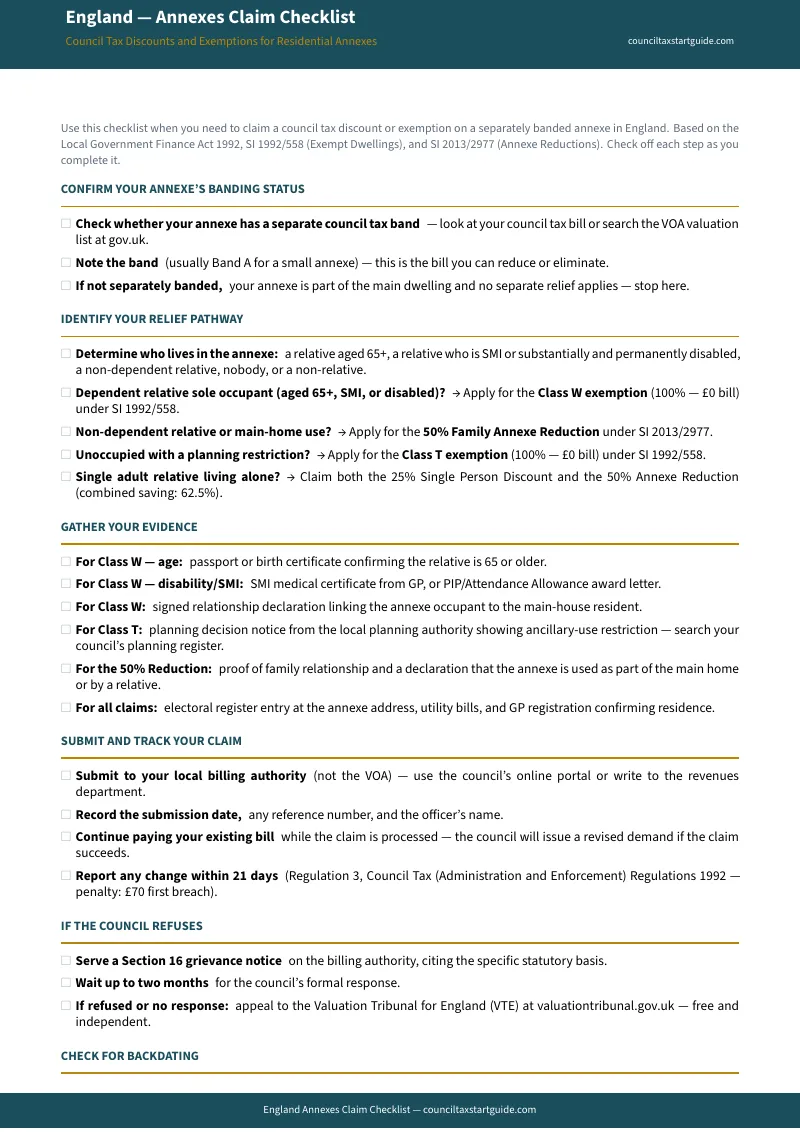
- checklist.pdf — England Annexes Claim Checklist (free, 2 pages, 22 items)
Instant PDF download. Start your claim tonight.
Full refund, no time limit. If this guide does not help you navigate the claim, email [email protected] for a full refund. No questions asked.
Not ready for the full guide? Download the free England Annexes Claim Checklist — a 22-item, 2-page checklist of which relief might apply, the evidence to start gathering, and the claim steps. It tells you what to do and in what order. The full guide tells you what to do when the council refuses, the VOA bounces you back, or the backdating gets complicated.
The relief is statutory. Your council owes it. This guide shows you how to claim every penny.
Frequently Asked Questions
What if the rules change after I buy?
We update the guide when the rules change. Email us any time, even years later, and we'll send you the current edition free.