
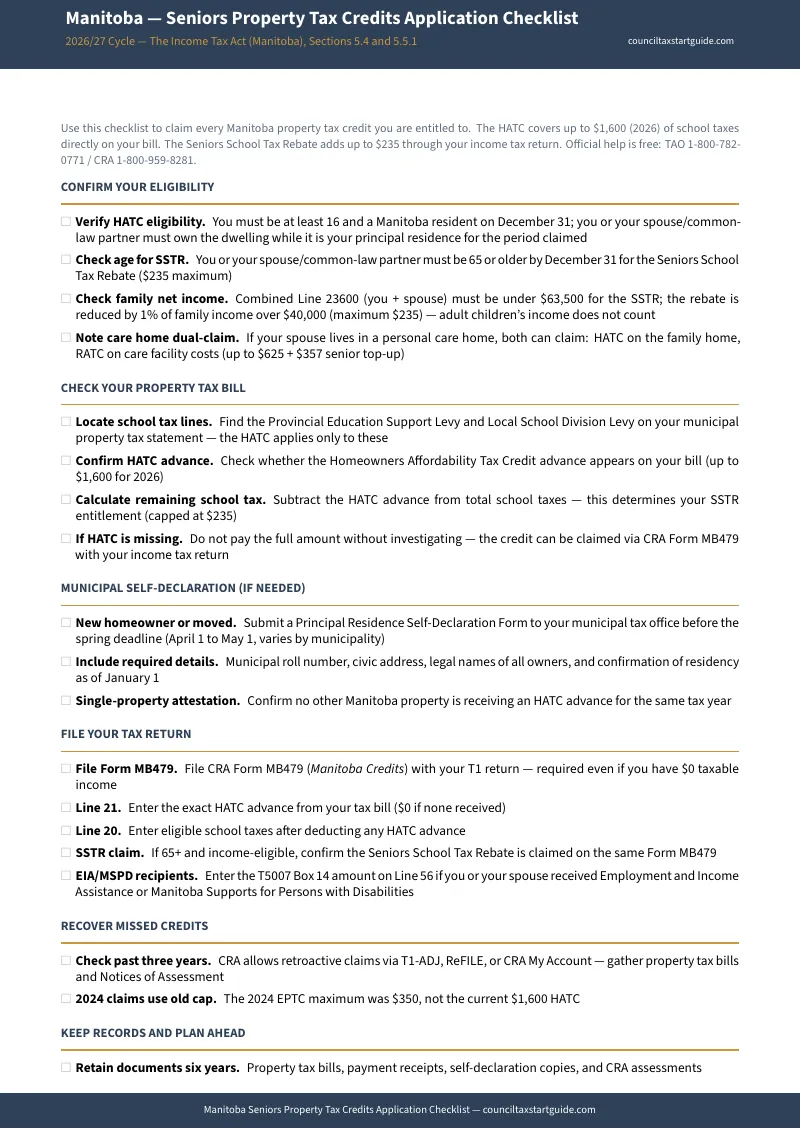
Your Tax Bill Shows One Credit. Manitoba Offers Three.
Manitoba replaced the old $350 Education Property Tax Credit with a new system worth more than four times as much — up to $1,600 through the Homeowners Affordability Tax Credit, plus an additional $235 through the Seniors' School Tax Rebate, plus a separate credit for renters that matters when a spouse moves into a care facility. The combined value can erase the school tax line on your property tax bill entirely.
The catch is that no single office handles all three. Your municipality applies the HATC advance to your tax bill — sometimes. The CRA processes the rest through Form MB479 when you file your income tax return. If you bought your home mid-year, transferred title, or received a supplementary bill, the municipal advance is missing entirely and nobody sends you a letter explaining that you need to recover it on your tax return. Seniors who qualify for the additional $235 rebate must claim it themselves — it is not automatic, even though the municipality already knows your age.
The Manitoba Property Tax Bill-to-Return Navigator is a single reference that maps all three credits into one claiming sequence: what appears on your municipal bill, what you file on your CRA return, what to do when the advance is missing, and how the programs interact when a spouse is in care. It includes the worksheets, the document checklist, and the retroactive recovery protocol so you are not starting from scratch with a stack of tax bills and five different government portals.
What's Inside
- Bill-to-return reconciliation worksheet — a line-by-line bridge mapping the school tax entries on your municipal property tax statement directly to the corresponding CRA Form MB479 fields, so you can see exactly how much credit was applied on the bill and how much you need to claim on your return
- HATC advance recovery protocol — step-by-step instructions for when the $1,600 credit is missing from your bill (new purchases, title transfers, supplementary statements), including the municipal self-declaration process and the CRA claim route with exact form references
- Seniors' School Tax Rebate walkthrough — the $63,500 family income threshold, the 1% clawback calculation above $40,000, the $235 maximum, and a worked example showing exactly how much a typical pensioner couple recovers
- Care home dual-claim guide — how HATC on the family home and RATC on care facility costs work together when spouses live separately for medical reasons, including the $625 renter credit plus the $357 senior top-up for 2026
- Three-year retroactive audit — a structured protocol for reviewing past CRA Notices of Assessment and filing T1-ADJ adjustment requests to recover credits missed in previous years, including the 2024 transition year when the old $350 EPTC still applied
- Assessment appeal guide — how the 2027 reassessment cycle works, how to read your assessment notice, grounds for appeal, and the Board of Revision process with filing deadlines
- Credit vs. payment plan comparison worksheet — a clear breakdown of non-repayable statutory credits (HATC, SSTR) versus monthly installment plans (TIPPS) and late-payment penalties, with a cost projection so you can see the real price of falling behind
- Family helper section — a document-gathering checklist for adult children helping a parent remotely, clarification that the helper's income has no bearing on the parent's eligibility, and Power of Attorney requirements for signing on someone's behalf
- Master document checklist — every piece of evidence sorted by which program needs it: property tax statements, CRA Notice of Assessment (Line 23600), self-declaration forms, T5007 slips for EIA recipients, and legal settlement sheets for title transfers
Who This Guide Is For
- Manitoba homeowners aged 65 or older who want to make sure they are claiming every credit available under the new system — not just the one that appears on the bill automatically
- Adult children helping an aging parent — locally or from across the country — who need one organized list of documents, deadlines, and forms instead of five different government portals
- New homeowners and recent title transfers who received a supplementary or added tax bill with no HATC advance and need to know the self-declaration process to get on the roll for next year while recovering this year's credit on their return
- Low-income homeowners under 65 who qualify for the HATC but may be missing the municipal advance or have unclaimed credits from previous tax years
- Families where one spouse is in a care facility who need to navigate the dual-claim scenario — HATC on the home, RATC for the care costs — and want to understand exactly how the credits stack
Why Not Just Use the Free Government Resources?
You should. The municipal self-declaration form is free. CRA Form MB479 is free. The Manitoba Tax Assistance Office answers questions at 1-800-782-0771. This guide links directly to all of them.
What those resources do not do is connect the dots. The City of Winnipeg explains how the HATC advance works on Winnipeg bills but says nothing about rural municipalities or the CRA filing. The CRA's MB479 instructions are written for tax professionals and assume you already know which lines from your property tax bill go where. The Tax Assistance Office can confirm policy but cannot walk you through a three-year retroactive claim while you are looking at your bill. And none of them explain that a municipal deferral — the option many low-income seniors reach for first — is a secured loan against your property title at 1.25% monthly interest, not a free benefit like the HATC.
The guide puts the full sequence in one place: bill, return, declaration, retroactive recovery, and the deferral trade-off — with worksheets designed for printing and filling in by hand.
What This Guide Is Not
This is an independent informational product. It is not affiliated with, endorsed by, or connected to the Government of Manitoba, the Canada Revenue Agency, the City of Winnipeg, or any other municipal or provincial body. It does not guarantee any credit, rebate, or deferral approval — eligibility is determined solely by government administrators and the CRA based on statutory criteria. It is not legal, financial, or tax preparation advice.
If you are facing a tax sale or severe tax arrears, you need free help now: contact Community Financial Counselling Services at 204-989-1913, the Credit Counselling Society at 1-888-527-8999, or A & O: Support Services for Older Adults at 204-956-6440. This guide is for process navigation and planning, not crisis intervention.
Your Purchase
You get instant access to 8 PDFs: the full guide (47 pages), the application checklist, and six standalone printable worksheets — the bill-to-return reconciliation worksheet, the three-year retroactive credit audit, the credit vs. payment plan comparison, the family helper handover pack, the municipal contacts quick-reference card, and the assessment appeal preparation worksheet. The checklist is also available as a free download so you can see the approach before committing.
Full refund, no time limit. If the guide doesn't help, email [email protected] and we'll refund every cent. No questions, no forms, no waiting period.
Get the Manitoba Property Tax Bill-to-Return Navigator →
Frequently Asked Questions
What if the rules change after I buy?
We update the guide when the rules change. Email us any time, even years later, and we'll send you the current edition free.