
Your property taxes are due. The government portal is a maze. The rules just changed.
BC property taxes keep climbing — Burnaby homeowners saw their bill nearly double in six years, even as assessments dropped. You know there's a provincial deferment program. You know there's a Home Owner Grant. But the Ministry of Finance has scattered the rules across a dozen different web pages, your municipal hall can't process applications any more, and the 2026 interest rate changes mean the old "defer and invest" strategy no longer works. One wrong step — deferring before you claim the grant, missing a consent deadline, miscalculating the equity threshold — and you're paying hundreds more in interest or penalties than you needed to.
The BC Property Tax Relief Navigator
This guide brings four government agencies' rules into one step-by-step workflow. Instead of jumping between the Ministry of Finance, BC Assessment, your municipal tax office and the Land Title and Survey Authority, you get a single document that walks you through every decision, every form and every deadline — in the right order, with verification checks built in.
It is not a summary of the rules you've already read on gov.bc.ca. It is a sequenced execution plan: what to do first, what to do next, what can go wrong at each step, and how to fix it if it does.
What's Inside
- The 2026 interest rate comparison — because "Prime plus 2%, compounded monthly" sounds abstract until you see the worked scenarios showing what a $5,000 annual deferral actually costs over 5, 10 and 15 years under the new rules versus the old simple interest rate. Includes the breakpoint calculation so you can see exactly when deferring stops making financial sense.
- Home Owner Grant optimisation — the basic grant (up to $570), the additional senior grant (up to $845), the low-income supplement, the $2,075,000 threshold phase-out formula and the minimum tax payment rule. Most importantly, the application sequencing decision: why you must claim the grant before submitting your deferment application, and what happens financially if you get it backwards.
- The eTaxBC portal walkthrough — step-by-step instructions for the online system that replaced municipal office applications in 2021. Covers BC Services Card login, PID lookups, co-owner consent submissions, annual renewal setup and how to check your deferment loan balance.
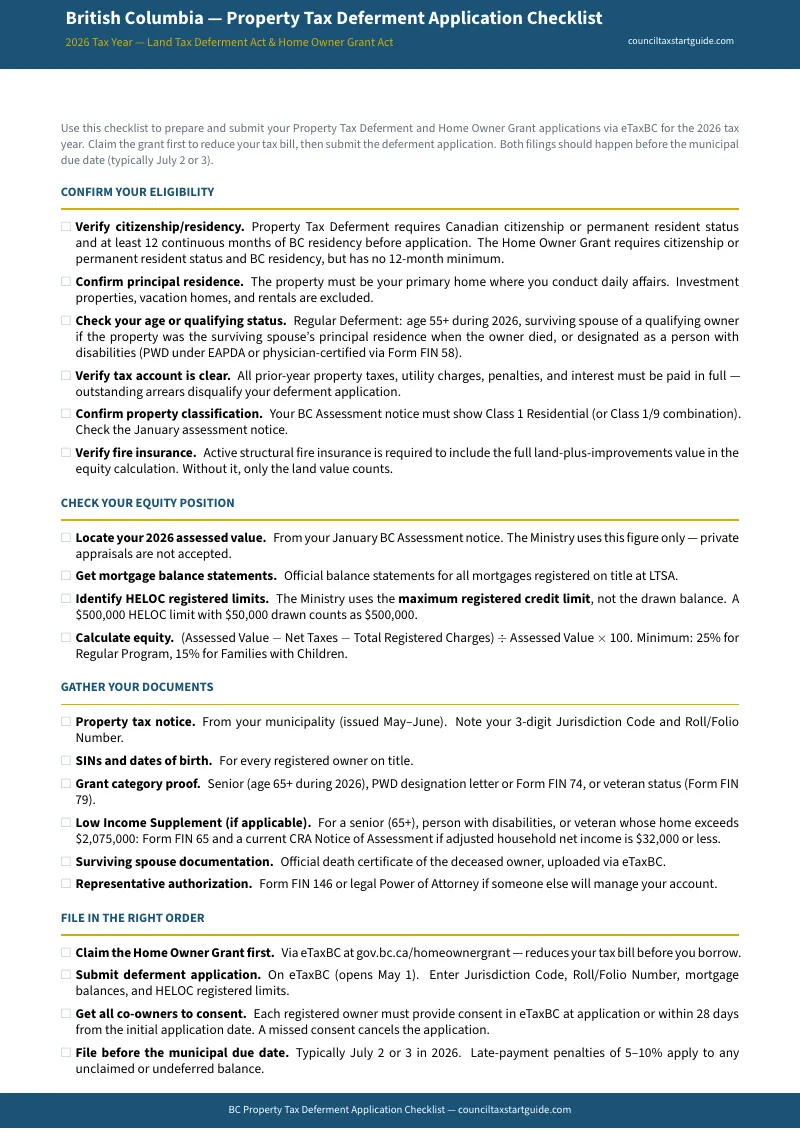
- The 28-day co-owner consent countdown — if you have a joint owner, a spouse who has passed away, or a family member on title, there is a strict 28-day window to sort consent or title changes after you apply. Miss it and the application is automatically cancelled. The guide includes the LTSA process for removing a deceased owner from title and the timeline for coordinating it with the deferment application.
- The equity threshold worksheet — the province requires 25% clear equity for the Regular Program and 15% for Families with Children. The guide shows how to calculate this when you have a mortgage, HELOC, second charge or existing deferment balance, and what to do if you're close to the limit.
- Repayment and payout letter procedures — the deferment lien sits on your title until you sell, transfer ownership or pass away. When that happens, you need a payout letter to freeze the interest and discharge the lien. The guide covers the request process, how online bank payments work (and the common mistake of paying without a payout letter), and what happens to the balance when a property moves through an estate.
- Assessment challenges — if your BC Assessment seems too high, you can challenge it through the Property Assessment Review Panel (PARP) and appeal to the Property Assessment Appeal Board (PAAB). The guide explains the free official route, the timeline and what evidence you need — because lowering your assessment also lowers your property tax and may bring your home back under the grant threshold.
- Six worked scenarios — a 68-year-old first-time applicant, a surviving spouse navigating title changes, a family helping an aging parent through eTaxBC, a homeowner near the equity limit, someone weighing the 2026 compound interest cost, and a homeowner moving into a care facility. Each scenario follows the full workflow from eligibility check to approval or repayment.
Who This Guide Is For
- Homeowners 55 and older considering the Regular Property Tax Deferment Program and trying to work out whether the new compound interest rate changes the calculation
- Seniors 65 and older who haven't claimed the additional Home Owner Grant or don't know how the threshold phase-out affects their property
- Surviving spouses who need to defer property tax while managing title changes after a partner's death
- Persons with disabilities qualifying for the PWD deferment stream and the additional Home Owner Grant
- Adult children helping a parent manage property tax applications, renewals and long-term financial planning
- Anyone who missed a prior year's Home Owner Grant and wants to make a retroactive claim before the December 31 deadline
Why Not Just Use the Government Website?
The official rules at gov.bc.ca are free, accurate and authoritative — and this guide links to them. The problem isn't that the information doesn't exist. The problem is that it's spread across four agencies, each with its own website and its own terminology, and none of them tells you what to do first.
The Ministry of Finance explains deferment eligibility on one page and interest rates on another, but doesn't show the combined cost over time. BC Assessment publishes your property value, but doesn't explain how it interacts with the grant threshold phase-out. Your municipal hall used to handle everything but now redirects you to a provincial portal. And the Land Title and Survey Authority handles the title changes that the deferment program requires — on a deadline that the deferment application page barely mentions.
This guide connects the steps. It puts them in order. It shows you the numbers. It flags the deadlines that cause cancellations. You could piece it all together yourself, but the guide saves you the research, the cross-referencing and the risk of getting the sequence wrong.
What You Get
The download includes the full guide (50 pages), a printable two-page checklist covering eligibility, documents and deadlines, and six standalone worksheets designed to print and work through with a pen: an eligibility verification sheet, a 2026 interest cost comparison, an equity calculation worksheet, an eTaxBC submission tracker, a co-owner consent and title change timeline, and an annual renewal planner — eight PDFs in total.
Satisfaction Guarantee
Full refund, no time limit. If the guide doesn't help, email [email protected] and you'll get your money back.
Get Started
Download the free checklist to see if this applies to you. If it does, the full guide — — walks you through every step from eligibility check to approved deferment, with the worked numbers to make the decision with confidence.
Frequently Asked Questions
What if the rules change after I buy?
We update the guide when the rules change. Email us any time, even years later, and we'll send you the current edition free.