The Council Said No — and Now You're Running Out of Time
Your council rejected your claim for a discount, exemption, or reduction. Or the VOA refused to change your band. You know the decision is wrong, but the letter doesn't tell you how to fight it — just that you can appeal to something called the Valuation Tribunal for England. You looked online: GOV.UK says "write to the council first" and the VTE site says "submit your evidence." Neither tells you what counts as a valid grievance, what evidence the panel actually weighs, or what happens if you miss the two-month window that's already ticking.
Phone calls and complaint emails don't protect your statutory rights. A tribunal appeal requires a chain of formal written steps — each with its own deadline — and one wrong move can lock you out entirely. Meanwhile, commercial firms will handle banding cases for 25–30% of any refund, but they won't touch discount refusals, exemption disputes, or Council Tax Reduction appeals. Those cases are yours to run.
The Appeal Navigation System
The Appeal Navigation System inside this guide replaces the guesswork with a structured route through every type of council tax dispute that can reach the Valuation Tribunal. It starts by identifying which statutory pathway your case follows — VOA banding proposal, Section 16 billing grievance, or Council Tax Reduction review — then walks you through the prerequisite steps, the evidence the tribunal expects, and the deadlines that govern each stage.
The guide covers the full journey: from drafting a compliant written grievance that starts the statutory clock, through building an evidence bundle in the VTE's own STEP framework, to preparing for a hearing and verifying your refund afterwards. It works for every dispute type the Valuation Tribunal hears — bands, discounts, exemptions, premiums, reductions, and penalties.
What's Inside
- Dispute Route Classifier — not every council tax dispute follows the same path to the tribunal. This tool identifies whether your case is a VOA banding matter (formal Proposal route), a billing authority dispute (Section 16 grievance route), or a Council Tax Reduction appeal (internal review route), so you file through the correct gateway from the start
- Section 16 Grievance Template — a phone call or email to the council does not create a statutory right of appeal. The tribunal requires a formal written notice under Section 16 of the Local Government Finance Act 1992, with specific elements that general complaint letters miss. This template ensures your grievance meets the statutory threshold and starts the council's two-month response clock
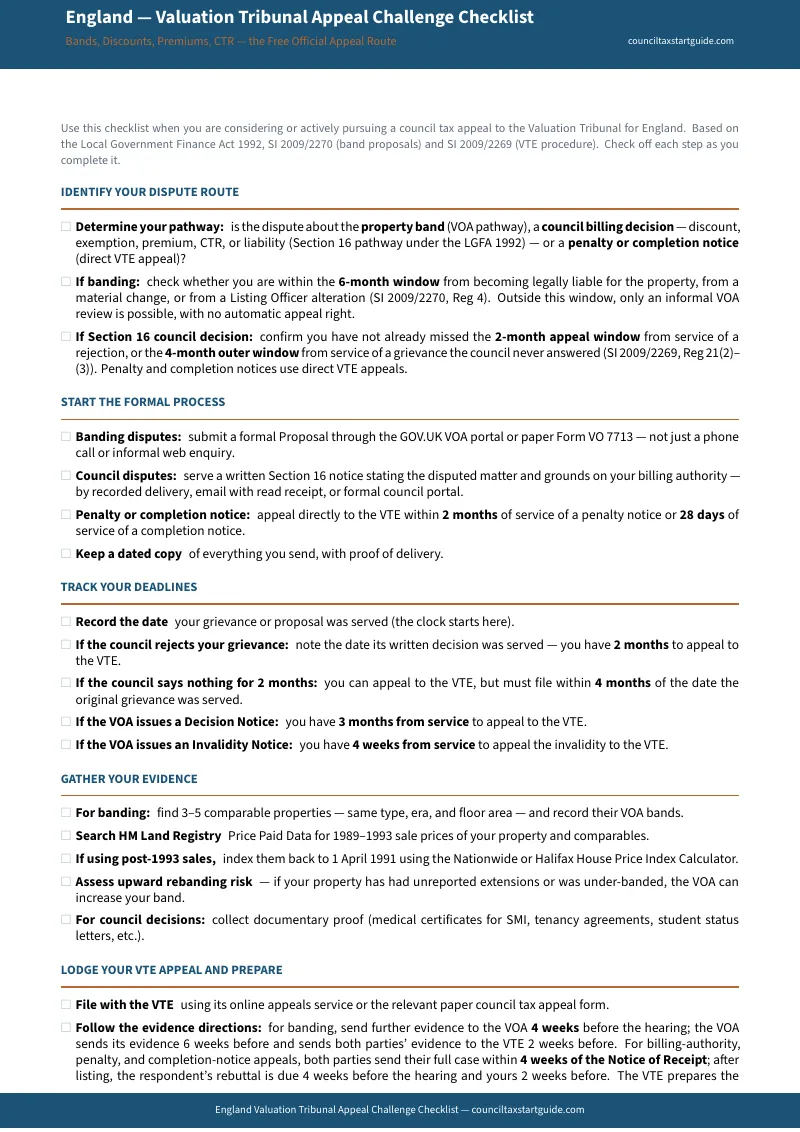
- Appeal Deadline Tracker — every route to the VTE has its own time limits: two months from a council refusal, four months if the council doesn't reply, six months for new-owner banding proposals, three months from a VOA Decision Notice (four weeks from an Invalidity Notice). The tracker logs every deadline from the date of service so you know exactly when each window opens and closes
- Evidence Index — the VTE uses its STEP framework: Show, Tell, Evidence, Provide. For billing, penalty, and completion-notice appeals both sides usually submit within four weeks of the Notice of Receipt; banding follows a hearing-counted timetable. The index structures your documents against the STEP headings, with exhibit numbers and page ranges, so the panel receives a bundle in the format it expects
- 1991 Valuation Evidence Worksheet — for banding appeals, the tribunal evaluates evidence against the 1 April 1991 valuation date. Modern property values do not prove a 1991 price. This worksheet shows how to find comparable sales from 1989–1993, how to index later sales, and how to document differences between your property and its comparators in band, size, age, and type
- Hearing Day Checklist — VTE hearings are usually remote video. A decision on the papers is possible when all parties consent in writing; an in-person hearing can be requested where remote participation presents severe digital exclusion or disability access barriers. The checklist holds your opening statement, the evening-before and 30-minute checks, and the questions you will ask the panel
- Refund Tracker — when the tribunal rules in your favour, the council recalculates your bill — but not always correctly or completely. For banding reductions, refunds can be backdated to 1 April 1993. For discount or exemption disputes, the council applies the correct entitlement from the qualifying date. The tracker helps you verify that the revised bill matches the tribunal's decision
- Representative Authorisation Template — if you're appealing on behalf of a relative, the VTE accepts representatives, but the council and VOA need formal written authority before they will discuss the case. The template covers standard authorisation, lasting power of attorney, and deputyship scenarios
- Comparable Properties Log and Council Communication Log — a fill-in table for the five comparison parameters the tribunal weighs, and a chronological record of every letter, email, call, and portal message that becomes an exhibit
- Sibling guide routing — if your situation is a first-time claim for a discount, exemption, or reduction rather than an appeal against a refusal, the guide routes you to the right starting point so you don't file an appeal before you've filed a claim
Who This Guide Is For
- Householders whose council rejected a discount, exemption, or reduction claim and who want to challenge that decision at the Valuation Tribunal
- Anyone whose VOA banding challenge was refused and who wants to appeal to the Tribunal with structured comparable evidence
- Householders disputing a second home premium, empty home premium, or penalty charge that their council applied incorrectly
- Council Tax Reduction claimants whose award was refused, miscalculated, or not backdated and who want to appeal after an internal review
- Adult children, carers, or family members helping a relative navigate the appeal process — especially for SMI exemption or bereavement-related disputes
Why Not Just Use GOV.UK?
The official appeal route through the VTE is completely free — this guide never pretends otherwise. What GOV.UK gives you is the outline: write to the council, wait two months, appeal to the tribunal. What it doesn't give you is the detail that determines whether your appeal succeeds.
GOV.UK doesn't provide a Section 16 template that meets the statutory threshold. It doesn't explain how to structure your evidence in the VTE's STEP format, or how to calculate your exact deadline when the council ignores your grievance. It doesn't walk you through what happens at a hearing or help you verify that the council has applied the tribunal's decision correctly afterwards.
Claims management firms handle banding cases — typically 25% plus VAT (30% including VAT) of any backdated refund. But they focus almost exclusively on band reductions. Discount refusals, exemption disputes, premium challenges, and Council Tax Reduction appeals are left to the householder. This guide equips you for every type of dispute the Valuation Tribunal hears.
Satisfaction Guarantee
Full refund, no time limit. If the guide isn't what you expected, email [email protected] and you'll get your money back. No questions, no deadline.
Start Your Appeal
Download the free checklist to see whether your dispute qualifies for a tribunal appeal, or get the full Appeal Navigation System — with the Dispute Route Classifier, Section 16 Grievance Template, Appeal Deadline Tracker, Evidence Index, Hearing Day Checklist, and Refund Tracker — for .
Frequently Asked Questions
What if the rules change after I buy?
We update the guide when the rules change. Email us any time, even years later, and we'll send you the current edition free.