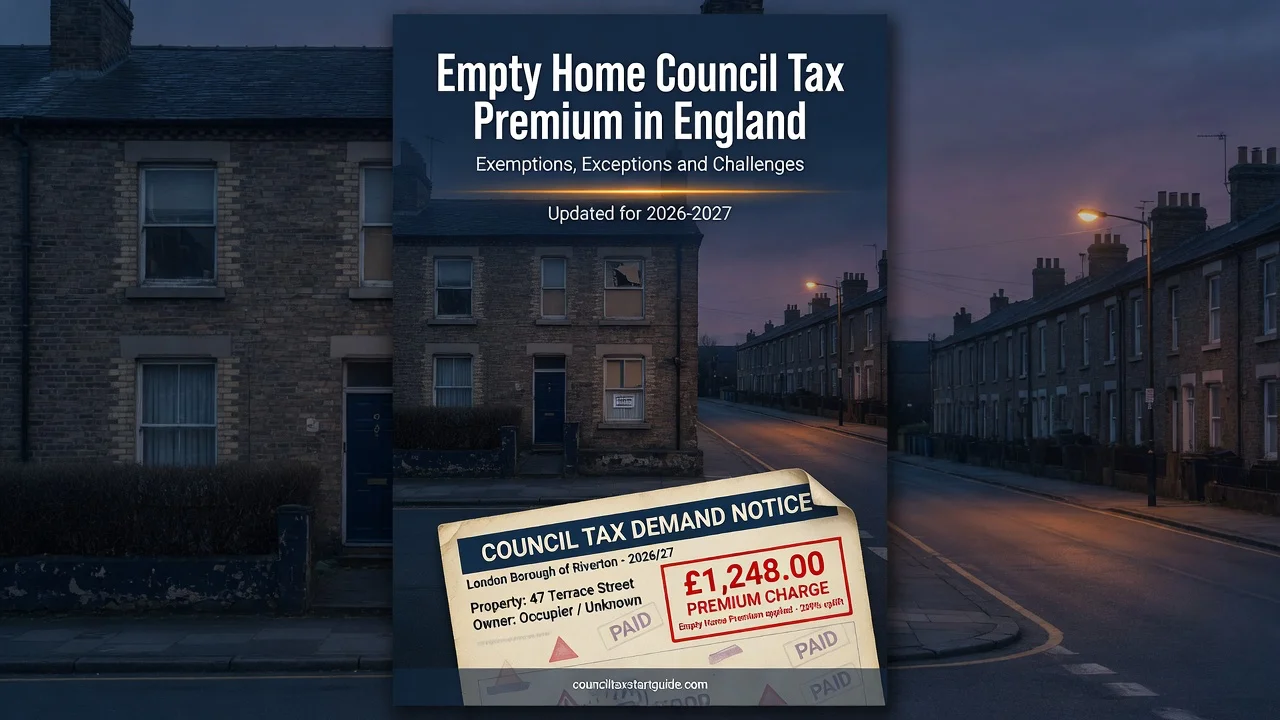
Your council doubled your bill on a home nobody lives in. The exceptions exist — you need to prove them.
Since April 2024, every council in England can charge a 100% premium on a home that has been empty for one year. After five years the premium rises to 200%, and after ten years it reaches 300%. A Band D property in an average English council now costs over £4,000 a year when the 100% surcharge hits — and for higher bands, the numbers climb fast.
But the same legislation that created these premiums also created mandatory exceptions. Statutory exemptions can wipe the bill entirely. Premium exceptions can remove the surcharge while you pay only the standard rate. The problem is that councils don't explain which route fits your property, what evidence they actually need, or what happens when a claim is refused. Their websites list the exception categories without the time limits, the evidence standards, or the classification rules that determine whether your property even qualifies under Section 11B or Section 11C.
That gap between knowing a protection exists and successfully claiming it is where most owners lose money — sometimes for months, sometimes for years.
The Evidence Audit System: One structured path from bill to resolution
This guide doesn't just list the exemptions and exceptions. It maps each one to the evidence your council actually evaluates, the time limits that apply, the timeline traps most owners miss, and the formal challenge route when things go wrong.
It's built around one principle: gather your evidence before you contact your council. Councils reject incomplete applications routinely, and every rejection adds months of premium payments while you resubmit. The guide organises everything — which protection applies to your situation, which documents to gather, where to submit, and what to do if the council says no — so your first application lands with a complete evidence file.
What's inside
- The two-part statutory test decoded — how councils determine whether your property counts as "empty" under the law (unoccupied and substantially unfurnished), why the classification matters, and what happens if your council gets it wrong
- Every statutory exemption relevant to empty properties — Class F (probate), Class E (care home or hospital), Class G (occupation prohibited by law), Class L (repossession), and others, with the duration rules and evidence for each
- All premium exception classes mapped in detail — actively marketed for sale, actively marketed for let, major repairs (Class M), probate transition (Class I), new owners, armed forces, and annexes, with the 12-month caps and the evidence that gets each one approved
- The probate timeline — four phases from death to premium exposure — how Class F and Class I interact, the exact handover dates, and the action steps for executors so there is never a gap in protection
- The six-week reset rule explained — what genuinely resets the empty-home clock, what councils treat as a contrivance, and why temporary occupation for less than six weeks changes nothing
- Renovation and structural works deep-dive — the Class M exception, the 12-month cap, what evidence councils require (building control notices, contractor schedules, structural surveys), and the VOA valuation list deletion route when 12 months is not enough
- Holiday lets and business rates — the 140/70-day threshold test for moving a property onto the non-domestic rating list, with a worked example
- Local discounts, Section 13A hardship relief, and backdating — there is no statutory time limit on backdating council tax exceptions in England, and the guide shows how to claim from the date your property first qualified
- The Section 16 challenge process — what to write in a formal grievance, the two-month response window, how to escalate to the Valuation Tribunal for England (free), and worked templates to track every deadline
- Five planning worksheets — property status classification, empty period timeline tracker, pre-submission evidence checklist, Section 16 grievance preparation, and dispute timeline tracker
Who this guide is for
- You've inherited a property and it's sitting empty while you wait for probate, find a buyer, or decide what to do with it
- You're selling a former home and the premium kicked in before the sale could complete
- You're a landlord between tenancies and the council has started charging a premium on your empty rental
- You're renovating a property and want to know whether the major-repair exception applies
- A family member has moved into a care home and their empty property is now accumulating premium charges
- You bought a property that was already empty and discovered the premium clock carries over from the previous owner
- Your council rejected an exemption or exception application and you want to challenge the decision properly
Why not just use the council's website?
Council websites list the exception categories. They don't explain which evidence gets approved, how the six-week reset rule actually works, what the probate timeline looks like phase by phase, or how to file a formal Section 16 challenge when a claim is refused. Claims management firms will do it for you — for 25–40% of any backdated refund, or a flat fee of £150–£300 up front. The exception routes themselves are completely free through your council and the Valuation Tribunal. This guide gives you the structured process to use those free routes yourself.
What you get
- guide.pdf — 12 chapters, 49 pages covering every exemption, exception, evidence requirement, time limit, and challenge step
- property-status-classification-worksheet.pdf — two-part s.11B / s.11C test before you pick an exception
- empty-period-timeline-tracker.pdf — vacancy, exemption, exception and six-week reset dates plus the 12-month / 5-year / 10-year milestones
- pre-submission-evidence-checklist.pdf — documents by exception class (G, H, I, M, E) and exemption evidence
- section-16-grievance-preparation-worksheet.pdf — draft the written notice, chronology, statutory basis and evidence index
- dispute-timeline-tracker.pdf — two-month grievance window, two-month VTE window, four-month silent-council window
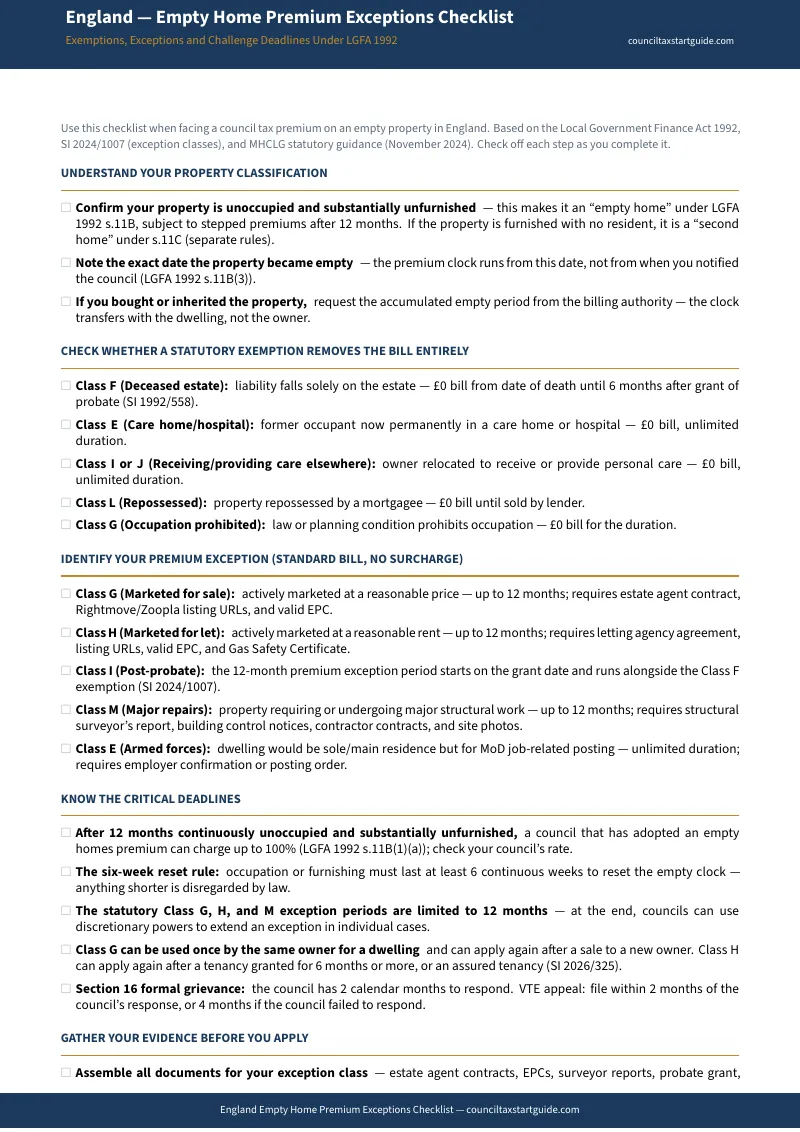
- checklist.pdf — the 2-page, 24-item exceptions checklist
All files are yours to keep permanently. Full refund, no time limit — email [email protected] if it's not right for you.
Not legal advice, not a council
This guide is published independently of every council, the Valuation Office Agency, the Valuation Tribunal and every government department. It explains the process and the evidence — it is not legal or tax advice. If you are behind on council tax payments or facing enforcement, please contact StepChange, National Debtline or Citizens Advice first.
Frequently Asked Questions
What if the rules change after I buy?
We update the guide when the rules change. Email us any time, even years later, and we'll send you the current edition free.