You Provide 35 Hours of Care a Week. Your Council Tax Bill Doesn't Know That.
You moved in with your mum after the dementia diagnosis. You manage the medication schedule, the GP appointments, the Attendance Allowance paperwork. You provide more than 35 hours of care a week and you have done for years. Somewhere in all of that, nobody told you that you should not be counted on the council tax bill — and that the discount can be backdated to the day you moved in.
You checked the council's website. It mentions a carer discount and links to a form. It does not explain that many council pages still list outdated qualifying benefits from before the 2013 PIP reforms. It does not tell you how to document 35 hours of weekly care in a way the revenues team will accept. It does not cover what happens when the council refuses to backdate, even though there is no statutory time limit. And if you care for your spouse or partner, it may not mention that partners are excluded by law — or that a different route through the Severe Mental Impairment disregard may still cut your bill.
The Carer Claim and Household Audit System is a structured toolkit that walks you through both routes to a council tax carer disregard — the unpaid family carer route and the low-paid live-in care worker route — from eligibility check to submitted claim, including the parts that council websites, Citizens Advice factsheets and charity guides leave out: how to calculate whether removing the carer drops the bill by 25%, 50% or 100%, how to build an audit-ready care log, how far back to backdate, and how to challenge a refusal at the Valuation Tribunal.
What's Inside the Guide
The Two-Route Eligibility Test — Mapped to Your Evidence
There are two legally distinct routes to a carer disregard: one for unpaid family or friend carers who provide 35 or more hours of weekly care, and one for low-paid care workers employed through a charity or local authority. The guide separates the eligibility conditions, exclusions and evidence requirements for each route, so you know before you contact the council which route applies and what to send. It also covers the statutory partner exclusion — the single most common reason claims are rejected — and what excluded carers can do instead.
The Complete Qualifying Benefits List for 2026/27
The care recipient must receive a qualifying disability benefit. PIP daily living (standard or enhanced), Attendance Allowance (any rate), DLA care (middle or highest), Armed Forces Independence Payment and Constant Attendance Allowance all qualify. The guide explains each benefit individually, including why PIP is the one most councils get wrong — a January 2026 MoneySavingExpert investigation found that at least 69 councils displayed outdated criteria omitting standard-rate PIP daily living, and another 80 published no accessible benefit information at all.
The Weekly Care Activity Log
The 35-hour threshold is the core eligibility condition for unpaid carers, but most councils provide no template for recording care hours. The printable care log in the guide gives you a structured week-by-week format that satisfies the revenues team without requiring formal social services intervention. It covers the activities that count, how to handle overnight supervision and irregular routines, and what happens when care hours fluctuate week to week.
The Household Occupancy Calculator
The size of the discount depends entirely on who else lives in the property. When a carer is disregarded, they stop counting as an adult for council tax purposes. If that leaves one countable adult, the household gets a 25% single-person discount. If all adults are disregarded — which happens more often than people expect, particularly when an SMI disregard applies alongside a carer disregard — a 50% discount or a 100% Class U exemption follows. The guide includes a household composition worksheet that maps every common living arrangement to the correct outcome.
The Backdating Calculation Sheet
There is no statutory time limit on backdating in England. The discount runs from the date all qualifying conditions were first met simultaneously — even if that was years ago. A family that could have claimed for the past six years may be owed several thousand pounds. The worksheet walks you through aligning care start dates, benefit award letters and address history across multiple tax years, so you can calculate the refund and submit a backdating request with the dates already documented.
The Claim Submission Process — Step by Step
How to find your council's application route, what evidence to attach, how to submit with proof of delivery, and what the council's response timeline looks like. Covers both online portals and paper-based councils. Includes a correspondence tracker so you have a dated record of every interaction.
When the Council Says No — Internal Review and Valuation Tribunal Appeals
Councils sometimes refuse claims or refuse to backdate. The guide covers the formal written grievance under section 16 of the Local Government Finance Act 1992 (what the letter must identify, which statute to cite, and what to attach), the formal appeal to the Valuation Tribunal for England (free to file), the strict two-month deadline after a written refusal, and what to expect at the hearing.
The Class J Exemption — Your Carer's Vacated Home
If you left your own home to move in with the person you care for, your vacated property may qualify for a Class J council tax exemption — meaning you pay nothing on that property while the care arrangement continues. The guide covers the qualifying conditions, how Class J protects you from empty-home premiums, and what happens when the care arrangement ends.
Six Standalone Printable Worksheets
Eligibility Assessment Worksheet, Weekly Care Activity Log, Application Evidence Checklist, Household Occupancy Calculator, Claim Tracker and Backdating Calculation Sheet — each a separate printable PDF you can fill in with a pen, take to the council office, and keep on file.
Who This Guide Is For
- Adult children who have moved in with an ageing parent and provide 35 or more hours of weekly care — especially when the parent has dementia and both the SMI disregard and the carer disregard may apply simultaneously
- Live-in siblings, grandchildren, friends or other non-partner carers who need to understand the eligibility test, the partner exclusion, and the evidence the council requires
- Low-paid live-in care workers employed through a charity or local authority, who need to navigate the separate £44 earnings cap and 24-hour weekly threshold
- Families who have been caring for years without claiming, where backdating could mean a refund of hundreds or thousands of pounds
- Anyone whose council has refused a carer disregard application or refused to backdate, and who needs to challenge the decision through a formal review or tribunal appeal
- Spouses and partners of disabled people who are excluded from the carer disregard but may qualify for a discount through the SMI route instead
Why Not Just Use the Free Resources?
Citizens Advice, Carers UK, Age UK and MoneySavingExpert all publish useful introductory guidance on the carer disregard. None of them give you the operational tools to handle the parts of the claim that actually go wrong.
- Council websites provide the application form and a basic eligibility summary. But a national investigation found that over 100 councils displayed incomplete or outdated qualifying benefit criteria. Many council pages omit standard-rate PIP daily living entirely. The guide verifies every qualifying benefit against current statute and tells you what evidence to send for each one.
- Charity factsheets explain the rules clearly. They do not include a printable care log template, a household occupancy calculator, a backdating worksheet, or any guidance for challenging a refusal at the Valuation Tribunal.
- MoneySavingExpert's 2026 investigation raised awareness nationwide. Their editorial coverage is excellent for understanding the problem. It does not include downloadable tools, evidence checklists, or appeal frameworks for actually resolving it.
- Commercial claims management companies handle the process for you — and take 25% to 30% plus VAT of the refund. On a multi-year backdated refund of £3,000, that is £750 to £900 plus VAT. The claim process is free through the council. The guide shows you how to do it yourself.
Free resources explain that the discount exists. This guide gives you the tools to claim it, backdate it, and challenge a refusal — without paying a claims company a share of your refund.
— A Fraction of One Year's Discount
A Band D council tax bill in England averages over £2,200. A 25% discount saves roughly £550 a year. A household where both the carer and the cared-for person are disregarded saves £1,100 or more. Where Class U exemption conditions are met, the saving is the entire bill. Claims management companies take 25% to 30% plus VAT of any backdated refund they recover. This guide costs a fraction of a single year's discount, and you can use it for every year the discount applies.
Your download includes 8 PDFs, instant download:
- Council Tax Carer Disregard in England: Live-In Carers and Discounts Guide (43 pages) — both qualifying routes, all qualifying benefits for 2026/27, household occupancy calculations with worked examples, the 35-hour care log, backdating, Class J exemption for the carer's vacated home, internal review and Valuation Tribunal appeal guidance, and printable worksheets
- Eligibility Assessment Worksheet — two-route eligibility test with evidence inventory for both unpaid carers and employed care workers
- Weekly Care Activity Log — structured 7-day care hour tracker with activity categories
- Application Evidence Checklist — every document the council needs, matched to the qualifying route
- Household Occupancy Calculator — count disregarded adults and look up the correct discount
- Claim Tracker — dated log of every interaction with the council, including reference numbers and response deadlines
- Backdating Calculation Sheet — align care start dates, benefit awards and address history to calculate the full refund across multiple tax years
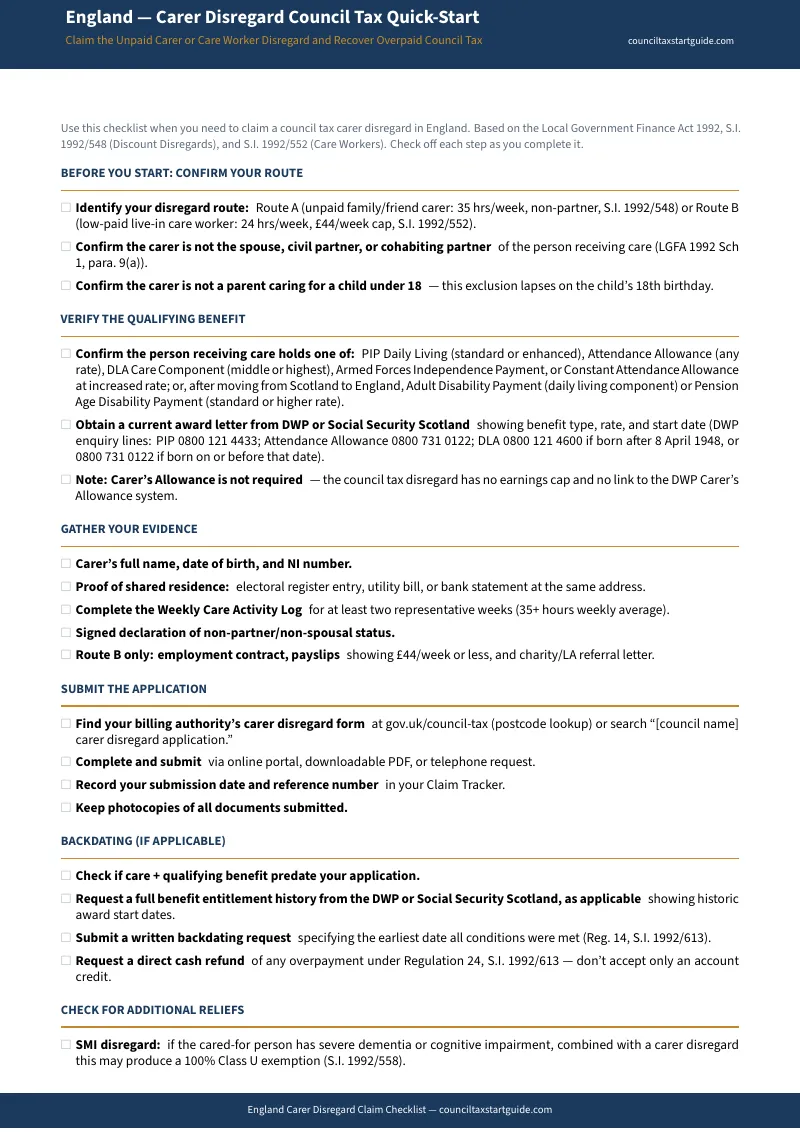
- Claim Checklist (2 pages, 25 items) — every condition, document and step in the carer disregard claim process, also available as a free standalone download
Full refund, no time limit. Questions? Email [email protected].
Frequently Asked Questions
What if the rules change after I buy?
We update the guide when the rules change. Email us any time, even years later, and we'll send you the current edition free.