Your Parent Moved Into a Care Home. The Council Is Still Billing the Empty House.
Your mother went into the care home three months ago. The house has been sitting empty ever since — you're waiting on the financial assessment, or putting it on the market, or just haven't had the energy to deal with it yet. Then the council tax demand arrives: full charge, no adjustment, as if nothing changed. Nobody at the care home told the council. Nobody at the hospital mentioned it. Social services didn't flag it. The entire burden of claiming the exemption falls on you.
You searched online. GOV.UK said "contact your council." Your council's website gave you a generic contact form and a paragraph about Class E. It did not tell you what evidence the revenue department actually requires, how to prove the move is permanent when it started as a hospital stay, what happens to the property while it's being sold, whether the house needs to be cleared of furniture, how far back you can claim, or what to do when the council rejects your application and you get a letter threatening a liability order.
The Care-Move Claim and Evidence System is a structured process-navigation toolkit that walks you through every stage — from identifying which statutory class applies to your situation, through gathering the specific evidence your council needs, to submitting the claim, requesting a backdated refund, and challenging a refusal through the free Valuation Tribunal. It covers the parts that council websites, Age UK factsheets, and Citizens Advice guides leave out: the decision framework that prevents you applying under the wrong exemption class, the permanence proof that councils actually accept, the backdating request that has no statutory time limit, and the formal appeal route when your council says no.
What's Inside the Guide
The Statutory Route Decision Flowchart — Class E, Class I, or Class J
Council tax exemptions after a care move are not one-size-fits-all. The law creates three distinct exemption classes, each with different qualifying conditions. Class E applies when someone moves permanently into a registered care home, hospital, or hostel. Class I applies when someone moves into a relative's home to receive personal care. Class J applies when someone vacates their own home to provide care elsewhere. Applying under the wrong class is the single most common reason councils reject care-move exemption claims. The flowchart walks you through the specific facts of your situation and identifies the correct statutory route before you contact the council.
The Evidence Assembly Checklist
Every care-move exemption requires proof that the person's sole or main residence has changed permanently. A temporary hospital stay does not qualify — but when a hospital stay becomes a permanent care placement, the exemption begins. Councils routinely reject claims because families cannot pinpoint the date the stay became permanent or cannot produce the right combination of medical and administrative evidence. The checklist maps exactly what constitutes permanence proof for each route: the care home admission contract, the GP's confirmation letter, the local authority social care assessment, the NHS Continuing Healthcare decision, and the courts' "sole or main residence" test from case law. It also dispels the widespread myth that furniture must be removed before the property qualifies — Class E applies whether the home is furnished or unfurnished.
The Retrospective Backdate Claim Builder
There is no statutory time limit on backdating a care-move exemption in England. The exemption applies from the day the qualifying conditions were first met — typically the date of permanent admission. If you discover the exemption months or years after the care move, you can claim the full period. The builder aligns the critical dates across financial years, calculates the overpayment, and structures a formal backdate request citing the relevant provisions of the Council Tax (Exempt Dwellings) Order 1992. On a Band D property averaging over £2,300 a year in 2026/27, two years of unclaimed Class E exemption is worth more than £4,600.
The Claim Tracker Log
Council tax departments operate independently from social care teams, hospital discharge planners, and care home admissions offices. Nobody cross-references records for you. The log tracks every communication with the council — dates, reference numbers, contact names, what was sent, how it was sent, and proof of delivery. When a council fails to process your claim or delays its response, the log provides the paper trail required to escalate to the Valuation Tribunal.
The Remaining Resident Household Audit — Discounts for Those Still Living There
When one person moves into a care home, the remaining household often qualifies for additional relief. A care home resident is disregarded under Schedule 1 of the Local Government Finance Act 1992 — they no longer count as an adult occupant. If only one non-disregarded adult remains, a 25% single person discount applies. If all remaining adults are disregarded (for example, a spouse with severe mental impairment), the discount rises to 50% or the property may be fully exempt. The guide explains how the disregard operates and how it stacks with Council Tax Reduction and the Disabled Band Reduction Scheme.
The Valuation Tribunal Appeal Workflow — When Your Council Refuses
If the council rejects your exemption claim or ignores it, you have a statutory right to appeal. Serve a written grievance under Section 16 of the Local Government Finance Act 1992. The council has two months to respond. If it refuses or fails to respond, you have a further two months to lodge a free appeal with the Valuation Tribunal for England — an independent tribunal whose decisions are binding on the council. The workflow covers the grievance letter structure, the statutory deadlines, what evidence to include, and what to expect at the hearing.
The Empty Home Premium Defence
Councils can charge premiums of 100% to 300% on properties empty for more than 12 months. Automated billing systems sometimes apply premiums to care-move properties by mistake. Properties qualifying for Class E, Class I, or Class J are statutorily exempt from empty home premiums. The guide includes a challenge template for any premium incorrectly applied to a care-move property.
Who This Guide Is For
- Adult children managing a parent's council tax after a move into a care home, nursing home, or long-term hospital care — whether or not you hold Lasting Power of Attorney
- Remaining spouses or partners who now live alone after their partner moved into residential care and need the single person discount on the occupied property
- Family members who have taken an elderly or disabled relative into their own home to provide or receive care, and the original home is sitting empty
- Carers who have left their own home unoccupied to move in with someone they look after full-time
- Anyone who has discovered an unclaimed exemption months or years after the care move and wants to backdate the claim to the original admission date
- Anyone whose council has rejected a care-move exemption claim or applied an empty home premium to a property that should be exempt
Why Not Just Use the Free Resources?
GOV.UK, Age UK, Citizens Advice, and local council websites all provide useful introductory guidance on council tax exemptions. None of them give you the structured tools to handle the parts of the claim that actually go wrong.
- Council websites provide the application form and a paragraph about Class E. They do not explain how to prove permanence when a hospital stay converts to long-term care, how to distinguish Class E from Class I or Class J, how to structure a backdated refund request, or how to challenge a premium applied to a care-move property. Each of England's 300+ billing authorities presents the information differently.
- Age UK Factsheet 21 provides an accurate legal summary of council tax exemptions. It is a narrative factsheet — it does not include evidence checklists, backdate request prompts, a claim tracker, or Valuation Tribunal appeal templates.
- Citizens Advice provides free advice, but local bureau appointments for specialist council tax casework can take three to four weeks. The guide gives you a structured workflow to submit your claim now instead of waiting for a callback.
- Claims management agencies handle the claim for you — and take 25% to 30% plus VAT of the backdated refund. On a two-year backdate worth £4,600, that is £1,150 to £1,380 plus VAT. The claim process through your council is free. The guide shows you how to do it yourself.
Free resources explain that exemptions exist. This guide gives you the decision flowchart, evidence checklist, backdate builder, and appeal workflow to claim the right exemption, recover the full refund, and challenge a refusal — without paying a claims company a percentage of your money.
— A Fraction of One Month's Council Tax
A Band D council tax bill in England averages over £2,300 in 2026/27. A successful Class E exemption saves the full amount — every month — for as long as the property remains empty. A two-year backdated claim is worth more than £4,600. Claims management companies take 25% to 30% plus VAT. This guide costs less than one hour of a welfare rights consultant's time, and you can use it for every year the exemption applies.
Your download includes 9 PDFs, instant download:
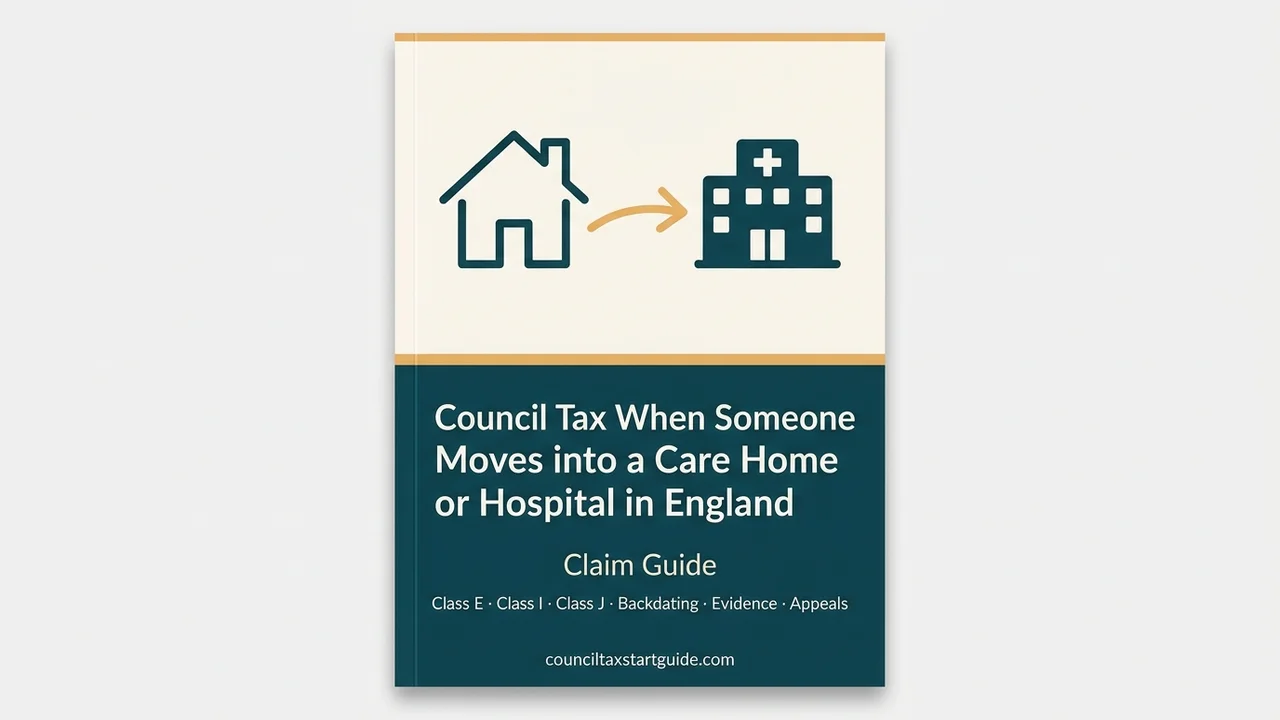
- Council Tax When Someone Moves into a Care Home or Hospital in England: Claim Guide (46 pages) — Class E, Class I and Class J, permanence evidence, backdating, remaining-resident discounts, the claim process, Valuation Tribunal appeals, empty home premiums, and key resources
- Statutory Route Decision Flowchart — tick the facts and write the class before you contact the council
- Evidence Assembly Checklist — tick each document as you gather it, by class, including authority and copies you keep
- Claim Tracker Log — one row per call, email, letter or portal event, plus statutory deadlines
- Retrospective Backdate Claim Builder — align the permanence date and calculate the overpayment for each tax year
- Remaining Resident Household Audit — count adults on the occupied property and look up 25%, 50% or Class U
- Valuation Tribunal Appeal Workflow — Section 16 grievance deadlines, letter fill-ins, and VTE hearing notes
- Empty Home Premium Defence — fillable challenge letter when a premium is charged on an exempt care-move property
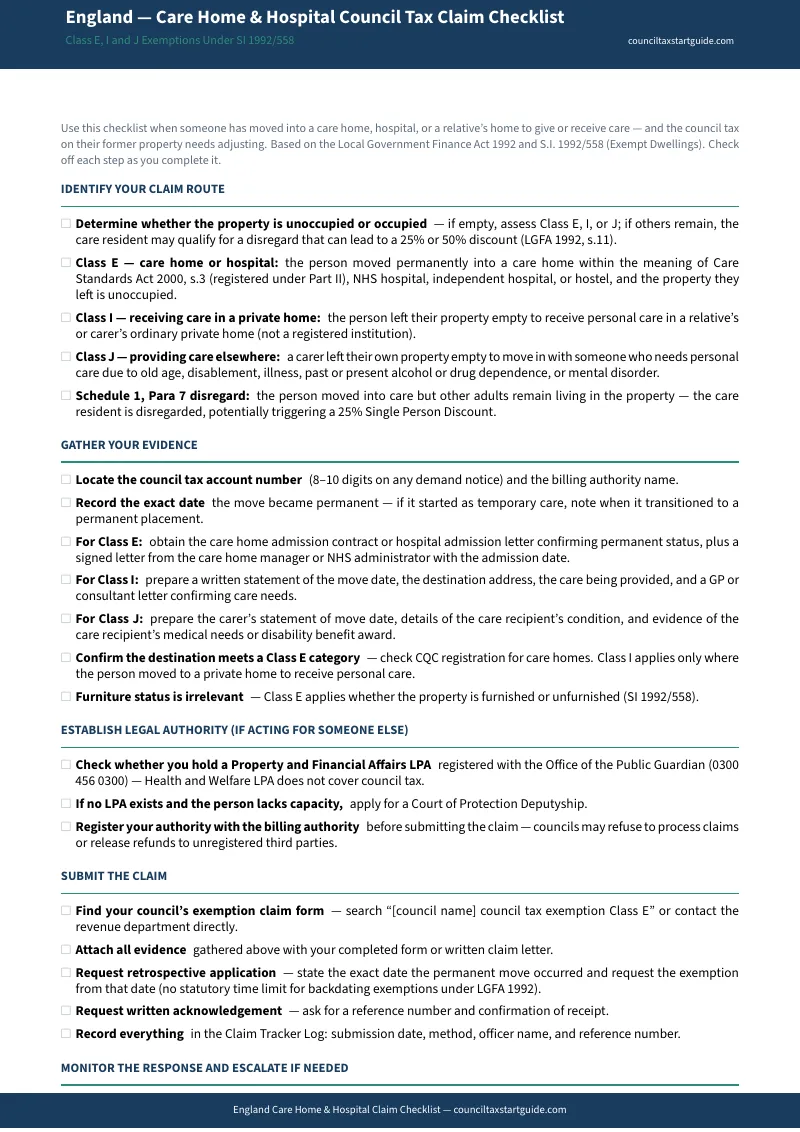
- England Care Home & Hospital Claim Checklist (free, 2 pages) — 23 items in 5 groups covering eligibility, evidence, authority, submission and escalation
Instant PDF download. Start your claim tonight.
Full refund, no time limit. If this guide does not help you navigate the claim, email [email protected] for a full refund. No questions asked.
Not ready for the full guide? Download the free England Care Home & Hospital Claim Checklist — a 2-page checklist of who qualifies, the evidence to gather, and the claim steps. It tells you what to do and in what order. The full guide tells you what to do when the council refuses, the backdate gets complicated, or the empty home premium arrives.
The council owes you an exemption. Possibly years of it. This guide shows you how to claim every penny.
Frequently Asked Questions
What if the rules change after I buy?
We update the guide when the rules change. Email us any time, even years later, and we'll send you the current edition free.