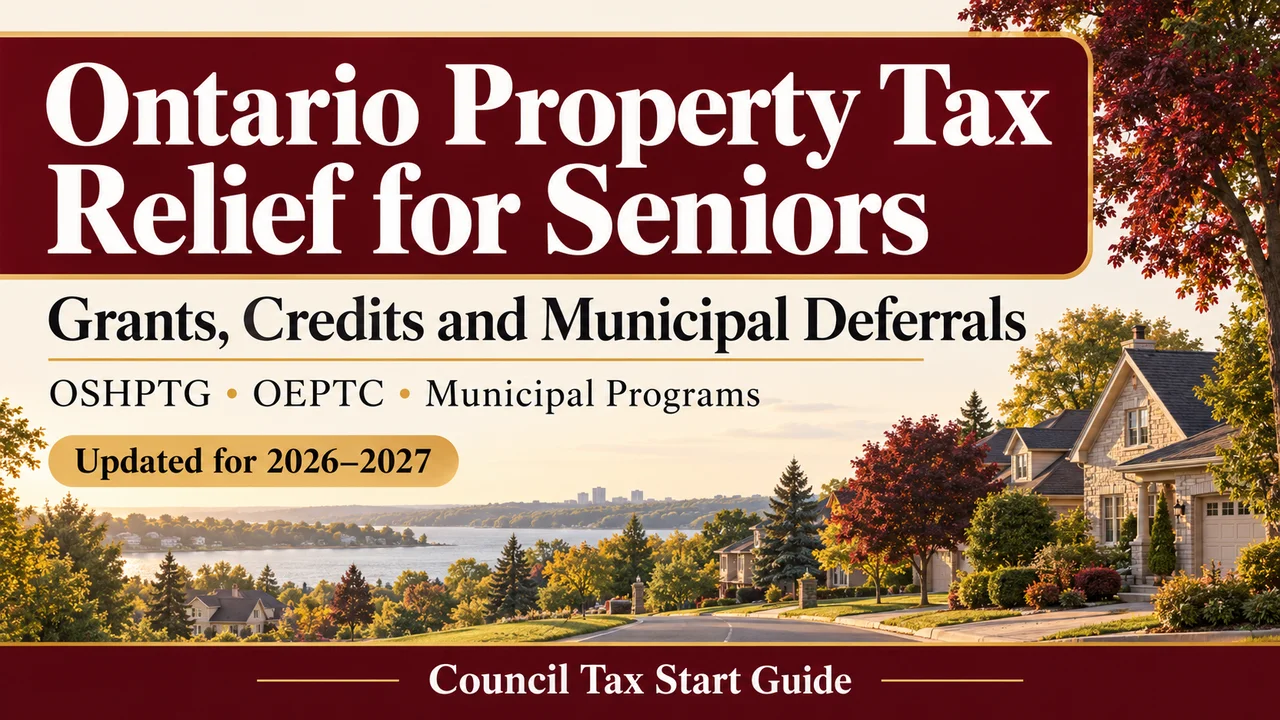
Ontario's property tax help is split across two governments — and most seniors are claiming from only one
If you own a home in Ontario, are 64 or older, and live on OAS, GIS or CPP, there is a good chance you qualify for property tax relief you have never claimed. The Ontario Senior Homeowners' Property Tax Grant pays up to $500 a year. The Ontario Energy and Property Tax Credit adds more through the Trillium Benefit. And dozens of municipalities — Toronto, Ottawa, Hamilton, London — run their own separate cancellation, deferral and rebate programs with different forms, different income thresholds and different deadlines.
The problem is that these two tracks do not talk to each other. The provincial credits are claimed on your tax return through Form ON-BEN and administered by the CRA. The municipal programs are applied for at your city's tax office with a separate form, a separate income test and a separate deadline. Your tax preparer handles one. Your municipality handles the other. Neither tells you about the other. And if you have been missing either — or both — for years, the CRA lets you backdate provincial claims for up to ten years, but most people do not know that.
The Dual-Track Property Tax Navigator
This guide maps both systems — provincial and municipal — into one organised workflow. Instead of reading government web pages that explain their own program in isolation, you get a single document that covers which programs you qualify for, how much each one is worth this tax year, exactly how to apply for each, what documents you need, how the two income tests differ, and how to recover years of unclaimed credits through the CRA's adjustment process.
It is the only guide that bridges the gap between the CRA and your city hall in plain language — with worked examples, a Form ON-BEN walkthrough, a municipal deferral decision matrix, and troubleshooting for the problems that trip people up most often.
What's Inside
- Provincial credits explained from eligibility to payment — the OSHPTG ($500 maximum, $35,000/$45,000 thresholds, 3.33% phase-out formula) and the OEPTC as part of the Ontario Trillium Benefit, including how they interact when you qualify for both, and the monthly vs lump-sum payment rules
- Form ON-BEN line by line — how to report property taxes on jointly owned homes, properties held in family trusts, and what to enter when you and your spouse file separately or are separated but sharing the same property
- CRA audit response protocol — what to do when a review letter arrives asking for proof of property taxes paid, how to gather historical tax statements from your municipality, and how to respond without triggering a benefit clawback
- 10-year backdating roadmap — the Form T1-ADJ process for claiming missed OSHPTG and OEPTC credits going back up to ten tax years, with the supporting documents you need for each year
- Municipal relief programs compared — Toronto's Tax Increase Cancellation and Deferral ($62,000 household income threshold, November deadline, interest-free for low-income applicants), Ottawa's full and partial deferral (interest terms, equity security), and the general framework under the Municipal Act for other Ontario cities
- Deferral decision matrix — a structured worksheet to evaluate whether a municipal deferral makes sense for your situation, covering interest rate terms, property lien mechanics, equity impact over 5, 10 and 15 years, and the events that trigger repayment (sale, title transfer, long-term care, death)
- Caregiver authorisation checklist — CRA Form AUT-01 and municipal representative rules for adult children helping a parent, including the line between what a tax preparer handles and what requires a separate filing
- Six worked scenarios — single senior on OAS/GIS, couple with one spouse under 65, separated spouses in the same property, adult child on title for estate planning, senior entering long-term care, and a multi-year retroactive claim
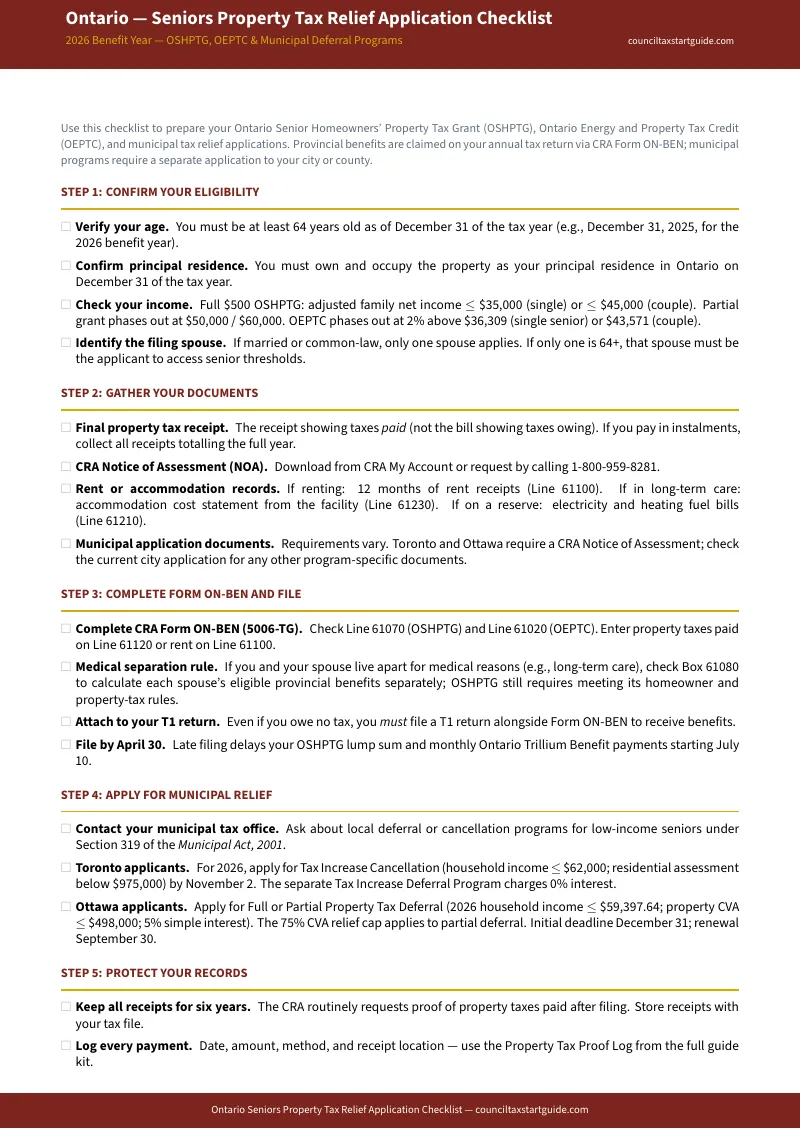
The kit includes five printable standalone worksheets: a provincial benefits calculator to estimate your OSHPTG and OEPTC before filing, a municipal deferral decision worksheet to project the balance and equity impact over time, a property tax proof log for CRA verification, a caregiver authorization checklist for family members helping with both tracks, and an agency communication log with key Ontario contacts. The printable checklist covers eligibility for both tracks, a document-gathering list (Notice of Assessment, property tax statements, proof of age, ownership proof), application steps, key deadlines and free support contacts.
Who It's For
- Ontario homeowners 64 or older on a fixed income who want to know every property tax credit and grant they qualify for — provincial and municipal
- Seniors who file a tax return but have never claimed the OSHPTG, or claimed it but not the OEPTC, or vice versa
- Homeowners who received a CRA review letter and need to respond with proper documentation
- Adult children managing a parent's property tax affairs who need to navigate CRA authorisation and the separate municipal application
- Low-income seniors considering a municipal deferral who want to understand the lien, the interest terms and what happens to the balance when they sell or pass away
- Anyone who just discovered they could have been claiming credits for years and wants to backdate through the CRA
Why Not Just Use the Government Websites?
The government websites are accurate — and free. Ontario.ca explains the OSHPTG. Canada.ca explains Form ON-BEN. Toronto.ca explains the tax increase cancellation. But each source explains only its own program, in its own terminology, with its own forms. None of them tells you:
- That the provincial credits and the municipal programs are completely independent — you can (and should) claim both
- How the income test for the OSHPTG ($35,000/$45,000 individual/couple net income) differs from Toronto's household income test ($62,000 combined) — and that qualifying for one does not mean you qualify for the other
- That your tax preparer almost certainly does not handle the municipal application, and CVITP free tax clinics do not assist with it either
- How to report property taxes when the home is jointly owned with a non-senior family member or held in a trust
- That the CRA allows retroactive claims for up to ten years using Form T1-ADJ — and how to get the historical property tax receipts you need
This guide connects the dots between the two systems so nothing falls through the gap between your tax return and your city hall.
Satisfaction Guarantee
If the guide does not help, email [email protected] for a full refund, no time limit. All official forms and government applications are free — the guide organises the process, it does not replace it.
Get Started
Download the free checklist to verify your eligibility and gather your documents. When you are ready for the full walkthrough — both provincial credits, municipal programs, the backdating process and the deferral decision matrix — get the complete guide for .
Frequently Asked Questions
What if the rules change after I buy?
We update the guide when the rules change. Email us any time, even years later, and we'll send you the current edition free.